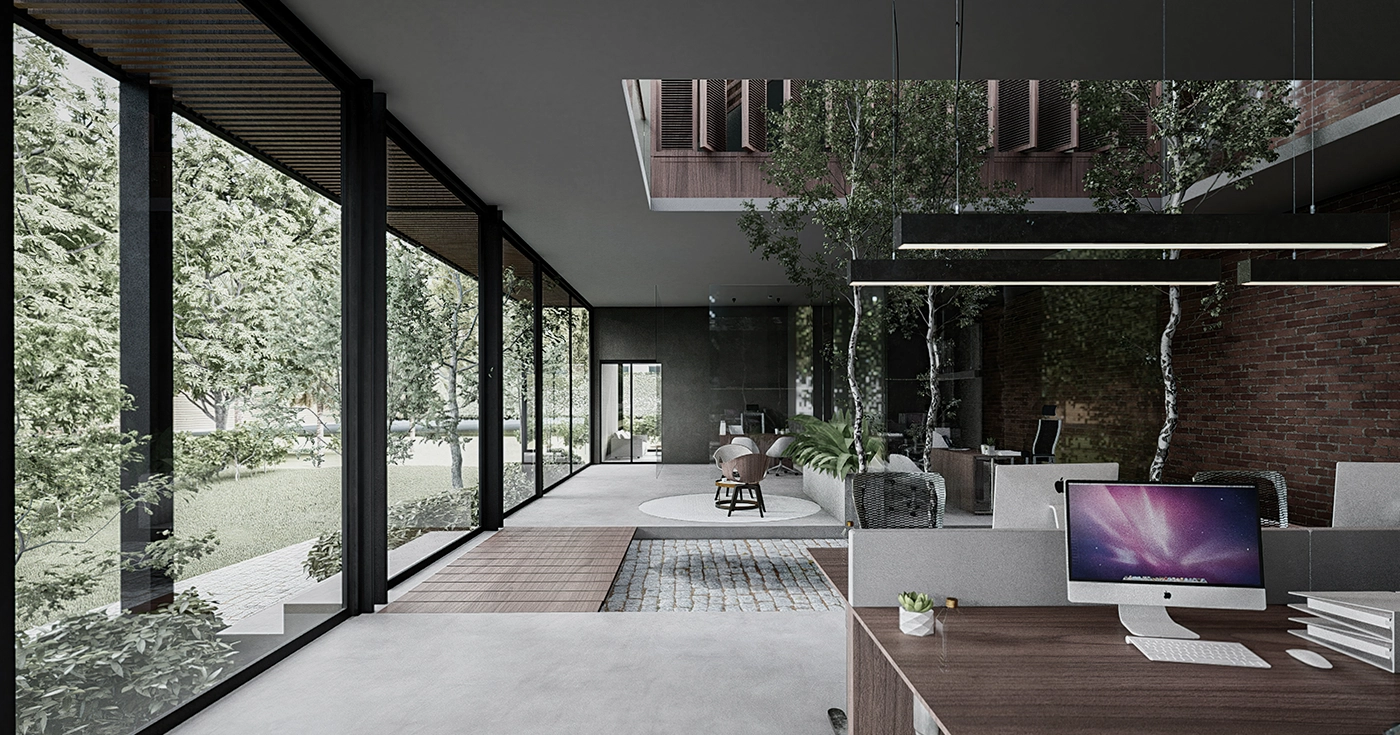

For years, the big question in the office market was whether offices would still make sense after remote working. Six years after the pandemic, the answer seems clearer. Offices have not disappeared, but the market has not returned to what it was before either. What is taking shape in Spain is not a uniform recovery, but a much more selective scenario in which demand is concentrated in a very small number of assets and leaves the rest behind.
Madrid and Barcelona reflect this clearly. Companies still need space, but not just any space. They are looking for high-quality, efficient, sustainable and well-located buildings. And that is where the real problem appears: available supply in that segment is increasingly limited.
Offices are not disappearing: the type of demand is changing
The hybrid model has become established in many companies, but this has not led to a linear fall in demand. What has changed is the type of property companies are looking for. Many have used recent years to review their real estate strategy and focus on buildings capable of attracting talent, improving the employee experience and meeting higher sustainability and efficiency requirements.
This shift is clearly rewarding the best assets. According to a report by CG Capital Europe, the availability rate for Grade A offices in the main financial districts of Madrid and Barcelona stands below 1%, an extraordinarily low level that highlights the shortage of truly competitive product in both markets.
We are therefore not seeing a return to the previous market, but a market that remains alive, yet is increasingly concentrated.
Madrid and Barcelona: less stock, more pressure
Madrid remains Spain’s largest office market and one of the most active in southern Europe. But the lack of new supply in the most established locations has become one of its main bottlenecks. Availability within the M-30 is at minimum levels. According to Savills, the residual rate in this area is barely around 2.6%, well below the market average.
In addition, before 2027 only three significant new projects are expected to be delivered in central Madrid, adding just over 32,000 square metres. Although there are refurbishment and repositioning operations underway, new supply remains limited compared with current demand. The most visible consequence is pressure on rents: prime offices are already approaching €45 per square metre per month and, in locations such as Azca or Barrio de Salamanca, highs of up to €48 have been recorded.
Barcelona shows a similar trend, although with slightly more availability. Demand continues to focus on modern and efficient buildings, and according to CG Capital Europe around 70% of transactions correspond to Grade A and B+ assets. Savills, meanwhile, highlights year-on-year rental increases of more than 20% in certain prime areas, confirming that pressure on rents also continues to rise.
The problem is not only demand: supply is not arriving
The shortage of prime offices is not explained solely by companies preferring better buildings. It is also influenced by the fact that the market is finding it increasingly difficult to generate new quality supply in the short term.
Construction costs remain high, urban planning processes are long and complex, and regulatory requirements around sustainability and energy efficiency are now much more demanding than a few years ago. All this slows the creation of new competitive stock.
Another relevant phenomenon adds to this context: the conversion of office buildings to other uses. In many central areas, some properties are being converted into residential, hotel or mixed-use schemes, partly because these uses can offer higher returns for owners. The result is that available office stock is shrinking just when demand is more concentrated than ever in a very specific segment.
Prime strengthens while secondary stock is left behind
This is the major underlying shift. What is taking place is not only a recovery of prime product, but a growing polarisation of the market. Buildings capable of responding to occupiers’ new requirements are strengthening their position, while part of the secondary stock risks becoming misaligned with what companies are looking for today.
The consequence is twofold. On the one hand, the best assets gain the ability to attract demand and sustain rents. On the other, many less competitive buildings face a risk of obsolescence if they cannot easily adapt to new standards in design, efficiency, services and user experience.
More than a recovery, a much more demanding market is taking shape
The shortage of prime offices is not driving a new phase for the whole market equally, but above all for its most competitive segment. Madrid and Barcelona clearly show this dynamic: less available supply in quality assets, more pressure on rents and a widening gap between the product that adapts to the new demand and the product at risk of being left behind.
Rather than a return to the pre-pandemic market, what is taking shape is a narrower, more selective and more polarised office market, where asset quality matters more than ever.