
So-called alternative assets are no longer a peripheral category within real estate investment. Healthcare, senior living, data centres and life sciences are attracting increasing amounts of capital, but they also require analysis to incorporate variables that carry less weight in traditional segments. It is no longer enough to study the property: it is necessary to understand the business taking place inside it.
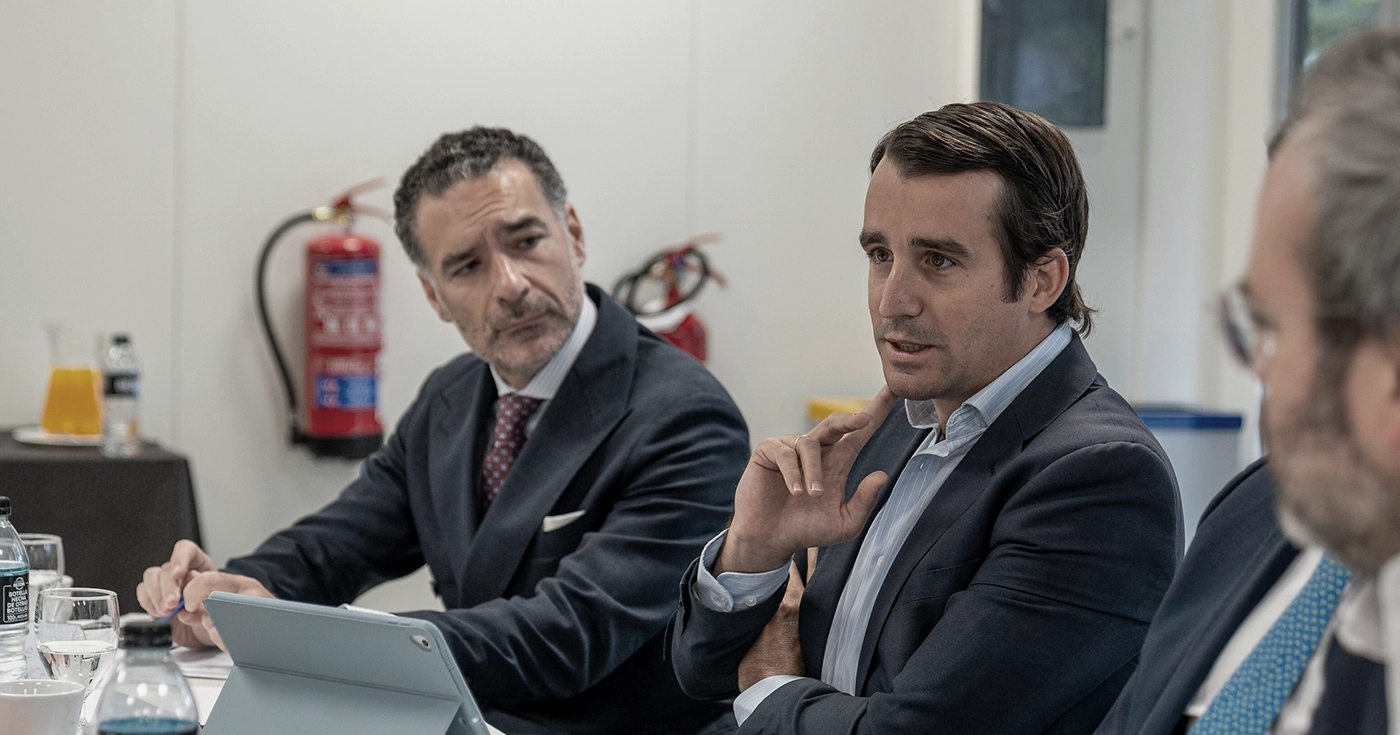
This was one of the main conclusions of the editorial breakfast “The opportunities of alternative assets”, organised this Wednesday, 17 September, by Observatorio Inmobiliario at the ESCP Business School headquarters in Madrid. Urbanitae took part as sponsor of the event and was represented by Gonzalo Navarro, Investment Director.
The panel also brought together representatives from Azora, Nhood, JLL, Healthcare Activos and Clifford Chance, in a discussion moderated by Teresa Montero, director of Observatorio Inmobiliario, and Roger Cooke, Editorial Advisor. Over more than an hour, the debate addressed the evolution of these segments, capital raising, the role of operators, regulation and the financing formulas needed to develop new projects.
Are they still really alternative?
One of the first questions that arose was the usefulness itself of grouping very different assets under the same label. Data centres, hospitals, residences and life sciences spaces respond to different demands, have different buyers and require specific financial and operational structures.
It is a distinction that Urbanitae already applies in its analysis. “Internally, we no longer like to label alternative assets as alternative,” explained Gonzalo Navarro. “Each one behaves differently, has different financing, different buyers and different demand.”
What many of them do share is the support of structural trends: digitalisation, population ageing, new care needs and the growth of certain infrastructures. This explains the growing interest from capital, but it does not automatically turn any project into a good investment.
For Urbanitae, the key remains the same as in any other asset class: analysing each opportunity on its own fundamentals and on the risk-adjusted return it can offer.
The operator moves to the centre of the analysis
The major difference compared with more traditional real estate appears when the asset’s operation depends directly on a business activity.
“When we present an opportunity in this asset class to our committee, the first thing we show is the due diligence we carry out on the company that will operate that asset,” Navarro noted. The question is no longer only where the property is located or how much it cost to build, but “who is going to operate the asset, how they are going to operate it and how they can make it reach the minimum return our investors are looking for.”
Healthcare is probably one of the clearest examples. Gonzalo de Troya, CIO of Healthcare Activos, highlighted during the event the appeal of a sector supported by structural demand and long-term contracts, but also the importance of selecting operators capable of providing high-quality care services.
At Urbanitae, we have seen this importance first-hand. In March, we financed Residencia Alameda, an operating senior residence in Torres de la Alameda, through a participating loan. The strategy specifically envisages the incorporation of one of the ten largest operators in the sector in Spain, the stabilisation of the asset and its subsequent sale to an institutional investor.
Senior living: demand exists, but the right product must be found
The discussion paid particular attention to senior living and the different residential and care solutions for an increasingly ageing population.
For Gonzalo Navarro, demand is beyond question, but there is still a lack of supply capable of correctly combining location, services and price. The market remains highly fragmented and there are significant differences between operators and products.
During the event, he explained that Urbanitae has visited numerous assets managed by private operators and has been able to see how professionalisation can transform their performance. In one of the operations analysed by the company, the change from a private operator to one of the sector’s major groups made it possible to improve both services and rents in a short period of time.
The challenge, therefore, is not simply to create more beds. It is about offering a product in which the user wants to live, integrated into its surroundings and with an appropriate service proposition. In this regard, both Navarro and other participants pointed to the current difficulty of finding competitive supply in certain mid-range price segments.
Alternative financing to cover gaps in the cycle
The specialisation of these assets also affects their financing. Many projects have strong fundamentals, but do not yet meet the conditions required to access traditional bank financing.
This is where alternative financing can play a particularly relevant role. Navarro explained that Urbanitae can enter precisely in those early stages, when a project still has development risk, lacks certain licences or is at a stage where banks cannot or do not want to participate.
The aim is not to replace bank credit. The objective is to cover specific gaps in the cycle and allow viable projects to reach the degree of maturity needed to subsequently access other sources of capital.
This is an idea that already appeared in our previous breakfast with Observatorio Inmobiliario on the residential market: alternative financing is increasingly becoming complementary financing, capable of adapting to the timing and specific needs of each operation.
Stable regulation to turn opportunity into investment
The potential of alternative assets in Spain was another point of consensus. The country has favourable factors such as demographic growth, infrastructure, the availability of renewable energy, quality of life and a growing capacity to attract international capital. But opportunity needs an environment that allows it to be executed.
One of the most repeated demands during the breakfast was precisely greater regulatory stability and predictability. Not necessarily less regulation, but rules known in advance, more agile procedures and more consistent criteria across administrations.
This issue is especially relevant in highly specialised segments. Data centres need to guarantee access to energy and power capacity; life sciences projects depend on ecosystems of talent, universities and companies; and healthcare requires balancing real estate requirements with intense care regulation.
For Urbanitae, this predictability is also a condition for mobilising capital. The clearer the framework of a project, the easier it is to assess its risks, structure its financing and attract the right investors.
From ‘alternative’ to a structural part of real estate
The conclusion of the event was less terminological than practical. Many of the assets that only a few years ago were grouped under the alternative label are entering a new phase of maturity.
But that consolidation does not mean the analysis becomes simpler. On the contrary: the more operational an asset is, the greater the specialisation it requires. The property, the operator, the financing, the regulation and the exit strategy are all part of the same equation.
Spain has the demand and the capital to continue developing these segments. The next step is to ensure that this opportunity translates into well-designed, financeable projects managed by operators capable of generating long-term value.