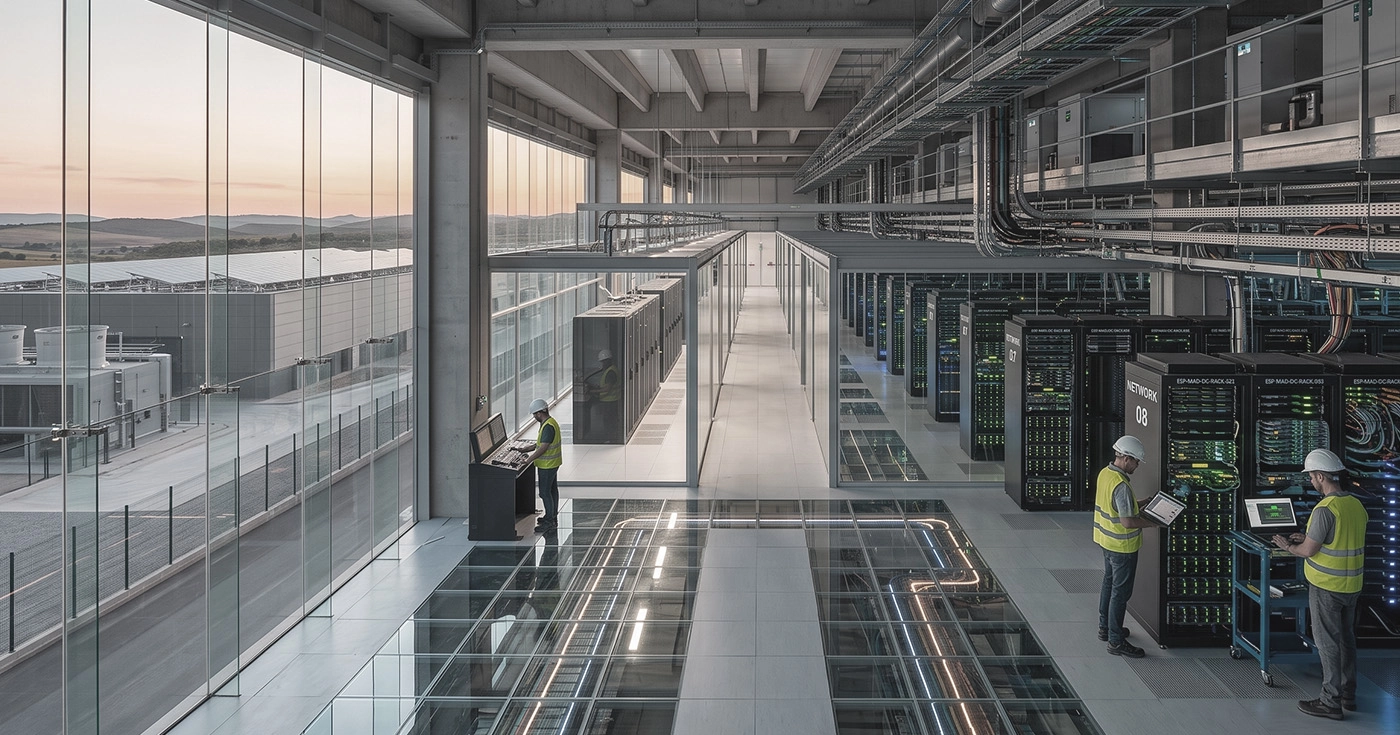

For years, data centres were considered an alternative asset, closer to technological infrastructure than to traditional real estate. However, the growth of artificial intelligence, cloud computing and the digitalisation of the economy is changing that perception.
These assets house the servers and equipment needed to process, store and transmit information. But their value does not depend only on the building or the land. It also requires access to power, connectivity, cooling, security and systems capable of operating without interruption. That is why data centres sit at the intersection of real estate, energy infrastructure and operating business.
Demand is growing, but development is becoming increasingly selective
Cushman & Wakefield’s Global Data Center Market Comparison 2026 report analyses 107 markets using 24 variables. Its main conclusion is that the sector has entered a phase of managed growth. Demand for computing capacity remains strong, but energy, regulation and capital are increasingly determining where new projects can actually materialise.
Global capacity under construction approached 31.7 gigawatts (GW) in 2025, more than double the figure in the previous edition of the report. However, a broad pipeline of announced projects does not guarantee that all of them will be delivered. Electrical connections, permits, financing and sufficient demand to occupy them must first be secured.
This is an important difference compared with the idea of unlimited growth. Investors no longer analyse only how much capacity can be expanded, but when that scale can translate into revenue, cash generation and profitability.
The building is only one part of the asset
A data centre is not simply a warehouse full of servers. Two properties with a similar surface area can have radically different values depending on their technical capacity.
Among the most relevant factors are:
- available power capacity and connection timeframe;
- the quality of the fibre network;
- cooling and backup systems;
- the possibility of expanding the facilities;
- energy efficiency;
- and the operator’s experience.
There are also different typologies. Hyperscale data centres serve the needs of large cloud and artificial intelligence providers. Colocation centres lease space and capacity to several clients, while edge centres are located close to the end user to reduce response times.
Each model has different requirements, contracts and sources of return. Therefore, talking about data centres as a homogeneous category can lead to misleading conclusions.
Spain is moving up the ranks as a European digital hub
Spain is gaining weight within the European market. Cushman & Wakefield places it in an accelerated growth phase, with Madrid as the main hub and total capacity close to 538 megawatts (MW) across operational, under-construction and planned facilities. The expected development places the country among the five European markets with the greatest potential according to the 2026 ranking.
Madrid ranks fifth among the primary markets in Europe, the Middle East and Africa, while Zaragoza appears in seventh place and Barcelona is listed among the tertiary markets. This presence reflects an expansion that is no longer limited to the capital.
Spain also has several competitive advantages: international connectivity, land availability, comparatively contained costs and growing access to renewable energy. Saturation and restrictions in traditional markets such as Frankfurt, London, Amsterdam, Paris or Dublin are also encouraging the search for new locations.
Arcano Research estimates that, if the planned development materialises, the industry could contribute up to €222.706 billion to Spanish gross domestic product over the next decade. This is an estimate of potential impact, not a guaranteed forecast, and depends on the announced investments being successfully executed.
Energy and permits determine viability
The main bottleneck is not demand, but the ability to bring projects to completion. An industrial plot may appear suitable, but it loses much of its appeal if it does not have sufficient electrical connection capacity or if that connection takes years to arrive.
Cushman & Wakefield notes that energy availability and regulatory support now carry more weight than demand alone in the choice of European locations. In addition, a growing share of projected capacity is difficult to execute due to grid limitations and permitting timelines.
In Spain, administrative procedures can stretch from the initially expected two years to nearly five, according to the Arcano report cited by Idealista. Added to this are the cost of infrastructure, the need for continuous supply and environmental requirements.
Local opposition is also increasing in some markets due to energy and water consumption, land occupation or the perception that these facilities generate less employment than expected. This can translate into new restrictions or moratoriums.
What an investor should analyse
The growth of the digital economy supports demand, but it does not guarantee the outcome of each project. Before investing, it is worth analysing:
- whether the power capacity is truly secured;
- when it will be available;
- who will operate the centre;
- which clients or contracts support the demand;
- how much capital the development requires;
- and what risks of delay or obsolescence exist.
The investment structure also matters. Financing the land acquisition is not the same as developing the building, acquiring an already leased asset or participating in the technological operation. Each phase presents different timelines and risks.
Data centres may benefit from structural trends, but they remain exposed to cost deviations, operator dependence, financing, regulation and technological change. A highly specialised facility can be difficult to adapt if it loses its main user.
The opportunity lies in execution, not only in capturing demand
Data centres are moving beyond being a technological curiosity to consolidate as a relevant category within real estate. Spain has the conditions to gain weight, especially thanks to Madrid and the development of new hubs.
But value does not lie only in having land available or anticipating an increase in demand. It lies in combining secured energy, connectivity, permits, capital and an operator capable of turning installed capacity into sustainable revenue.
In a sector shaped by large investments and long timeframes, the real advantage will not be building faster than everyone else, but developing viable assets in the locations where the infrastructure can truly respond.