For years, the office market was one of the pillars of real estate investment in major cities. However, the pandemic, the rise of remote work and changing working models created uncertainty about the future of this segment. Now, several years later, the market shows a more nuanced picture: corporate demand is still there, but it has become far more selective and is deeply transforming the type of assets that generate value.
In Spain, the most recent data reflects a market that is once again attracting the attention of investors and companies. Understanding these dynamics is key to identifying where the opportunities lie today within the office segment.
A market with solid demand
Despite changes in the way work is organised, demand for offices in Spain remains at significant levels. According to a report published by Cushman & Wakefield, Madrid closed 2025 with more than 517,000 square metres of leased office space, while Barcelona reached 317,000 square metres, figures that confirm the strength of occupier activity.
This volume shows that companies still view the office as a central element in their organisation, especially for fostering collaboration, corporate culture and interaction between teams. However, demand is no longer distributed evenly across all assets. The quality of the building, its location and its technical features have become decisive factors.
In this new context, high-quality buildings, classified as Grade A and B+ account for between 70% and 80% of leased space, driven by criteria such as energy efficiency, sustainability, connectivity and workplace wellbeing. This shift has reinforced the market’s polarisation: while modern assets continue to enjoy strong demand, older buildings face greater difficulties in attracting tenants.
Pressure on prime office space in central Madrid
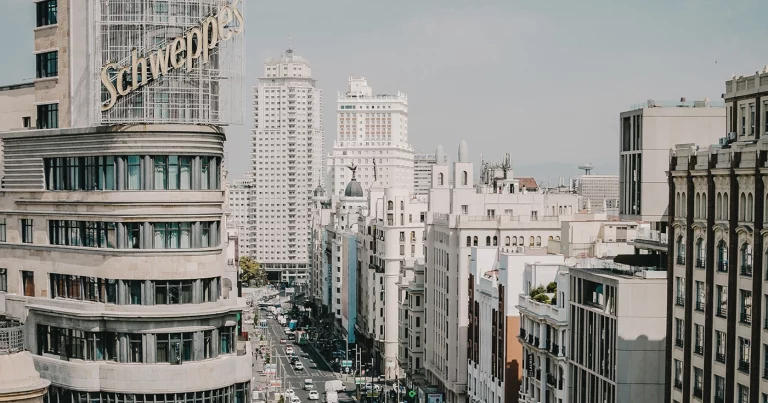
Madrid remains the country’s main office market and one of the most relevant investment hubs in southern Europe. In the last quarter of 2025, demand was especially concentrated in the city’s most central submarkets. This strong demand is taking place in a context of very limited availability. Vacancy rates stand at around 2.4% in Madrid’s CBD (Central Business District) and 4.9% in the city centre, levels that reflect a highly constrained market.
Prime rents closed 2025 at around €43 per square metre per month in Madrid’s CBD, while in Barcelona they reached approximately €31.5 per square metre per month. These figures are explained by the combination of active corporate demand and limited supply of modern office space in central locations. From an investor perspective, the office market is going through a phase of gradual recovery after the adjustment caused by the financial cycle shift and rising interest rates. Although activity remains selective, investor interest continues in assets with strong fundamentals.
The conversion of offices into housing
Alongside these dynamics, the real estate market is beginning to explore new solutions for part of the office stock that no longer fits today’s needs. In Madrid, the City Council has started discussions as part of the Plan Reside initiative to convert up to 2,000 offices into homes in the central district.
The initiative seeks to address one of the main challenges in the residential market: the shortage of housing in central and established areas. Reusing existing buildings makes it possible to increase housing supply without the need to develop new urban land, while also supporting more sustainable growth models.
This approach is based on public-private collaboration and on the idea of making use of underutilised assets to adapt them to the city’s current needs. The conversion of offices into homes is also becoming an established trend in other European capitals, where changing work patterns have left part of the office stock obsolete or underused. From an investor perspective, these change-of-use and repositioning strategies can become a relevant avenue for long-term value creation.
Offices as part of a real estate diversification strategy
In the current context, the office segment remains a relevant part of the commercial real estate (CRE) universe, which includes all non-residential real estate assets. This type of investment provides access to sources of return that differ from those of the housing market, generally linked to corporate lease agreements and the evolution of economic activity.
On real estate investment platforms such as Urbanitae, the development of projects within the commercial real estate space is an alternative way to access this type of investment with a low ticket size while prioritising diversification. It allows investors to participate in segments that were traditionally reserved for large funds or institutional investors, gaining access to structured transactions with different risk and return profiles.
In this sense, the office market is undergoing a profound transformation, marked by changes in the way people work, in occupier preferences and in the sustainability requirements of buildings.
Far from disappearing, the segment is evolving towards a more demanding model, where the quality of the asset and its ability to adapt to new business needs are determining factors. While prime spaces in central locations continue to show strong demand, decentralised areas are positioning themselves as the main engine of expansion for the coming years.
At the same time, the conversion of obsolete buildings into new uses — such as residential — shows how the real estate market continuously adapts to economic and urban change. For investors, understanding these dynamics is essential when identifying opportunities in a sector that remains key within the European real estate landscape.