Retail is attracting capital once again, although investors are becoming more selective, with greater emphasis on management, operator quality and value creation. These were some of the key takeaways from the editorial breakfast organised by Observatorio Inmobiliario, in which Urbanitae took part alongside representatives from Sonae Sierra, Gloval, Schneider Electric, Uría Menéndez, 4Retail, Women in Retail and La Vaguada.
Capital is turning its attention back to retail. Not according to the same criteria as a decade ago, but with renewed interest in assets offering opportunities to professionalise management, adapt the tenant mix or develop new properties in locations where demand has been demonstrated.
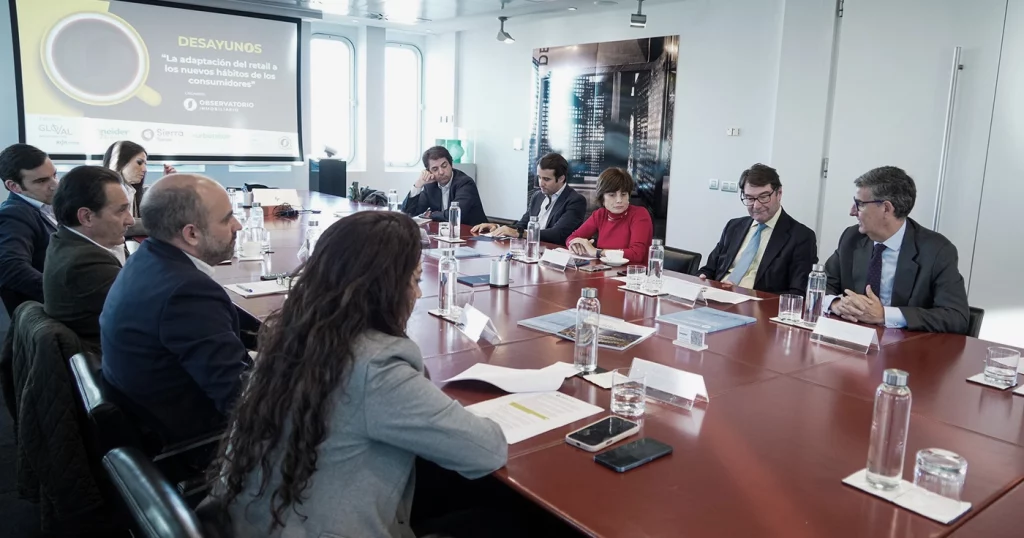
This was one of the main messages from the editorial breakfast “Adapting retail to changing consumer habits”, organised on 19 November by Observatorio Inmobiliario at the offices of Uría Menéndez in Madrid and sponsored by Urbanitae, Sonae Sierra, Gloval and Schneider Electric.
Urbanitae was represented by Gonzalo Navarro, Investment Director, alongside Enrique Suárez from Sonae Sierra; Héctor Pozo from RINA Prime Iberia-Gloval; Angélica Tarrasa from Schneider Electric; Diego Armero from Uría Menéndez; José Ramón Somoza from 4Retail; Cristina Delgado from Women in Retail; and Jesús Hernández from La Vaguada.
A more selective approach to retail investment
“Capital is increasingly returning to retail in a more selective way,” said Gonzalo Navarro. Some investors are looking for stabilised assets with long-term leases and predictable income. Others are prepared to pursue value-add strategies through new developments, repositioning or improvements to existing properties.
At Urbanitae, we are seeing particular interest in this second area, especially where demand is clear but the available supply has become outdated or is insufficient.
We have already applied this investment approach to specific transactions. At Parque Comercial Arlanzón, in Burgos, Urbanitae has financed two tranches totalling €5 million. We have also participated in office projects such as Mazarredo, in Madrid, where the two investment tranches amount to €4.22 million, and hotel projects such as Hotel Cruz del Campo, in Seville, with a further €5 million in equity.
The operator: a key factor in investment
“Ultimately, the operator is the one who makes the business profitable. Operations are what matter most,” Navarro explained. For investors, contractual stability and income visibility are important; for operators, flexibility to adapt to changing consumer behaviour is essential. Finding a balance between these needs is one of the sector’s major challenges.
The growing professionalisation of retail is helping in this respect. An operator’s experience, financial strength and guarantees are increasingly important when assessing an investment opportunity.
This is also why Urbanitae sees potential in secondary locations where there is genuine demand and operators willing to establish a presence. Value is not confined to the most competitive markets: in certain cases, developing or transforming properties where suitable supply is lacking can be particularly attractive.
Why retail parks are gaining ground
Retail parks featured prominently in the discussion. Héctor Pozo, from RINA Prime Iberia-Gloval, highlighted their physical flexibility, relatively straightforward operations and greater consistency in rental levels compared with other formats.
Gonzalo Navarro also emphasised this efficiency. Compared with properties that have numerous tenants and more complex management requirements, retail parks with large-format units can rely on a smaller number of professional operators, making them easier to analyse and manage.
The example of Parque Comercial Arlanzón, mentioned during the breakfast, illustrates precisely this approach: a secondary location with demand and interested operators, where there is scope to develop a property better suited to the market.
Consumers are driving the transformation of retail assets
Changing consumer behaviour was another central theme of the meeting. Enrique Suárez, from Sonae Sierra, pointed out that each property must evolve alongside its surroundings without resorting to standardised solutions. “There is a lot of data, but data alone is worth nothing. You need to know how to manage it, work with it and extract the information that really matters,” he said.
Jesús Hernández shared the experience of La Vaguada, where retail, food and beverage, services and leisure are combined to cater to very different visits, from a quick purchase to an extended stay.
This adaptation also has investment implications. Retail assets need professional management capable of identifying when to strengthen the tenant mix, transform spaces or introduce new uses to continue creating value.
Alternative financing as a complement to bank lending
Transforming an existing property or developing a new one requires capital structures tailored to each stage. Urbanitae participates in commercial real estate (CRE) through both equity and debt, always as a complement to bank financing. As Gonzalo Navarro summed up during the meeting, “we complement the banks”, particularly at stages when a lender is not yet willing to finance a transaction, even if the location, demand and business plan are sound.
There may be stages when a bank is not yet prepared to finance a transaction — for example, because leasing commitments have not been secured or operators have yet to be brought on board — despite a strong location, proven demand and a solid business plan.
Alternative financing can then help the project progress until it reaches a sufficient level of maturity to subsequently secure bank financing. It can also finance certain capital expenditure (CAPEX) associated with transformation projects when there is a clear income stream and a reasonable prospect of value creation.
Nearly €130 million in commercial real estate assets
Urbanitae’s growing activity in CRE is already reflected in our track record. To date, we have launched 71 commercial real estate transactions, providing nearly €130 million in financing. These include retail, offices, hotels, flex living, student accommodation, senior living, self-storage facilities and other specialist assets. Of these transactions, 37 have been structured as debt and 34 as equity.
Rather than focusing on a single asset class, we look for an attractive combination of demand, operator quality, financial structure and value-creation potential.
Retail is a good illustration of this philosophy: a sector undergoing transformation which, precisely for that reason, continues to generate opportunities for those capable of selecting the right assets, structuring investments appropriately and supporting them with professional management.