

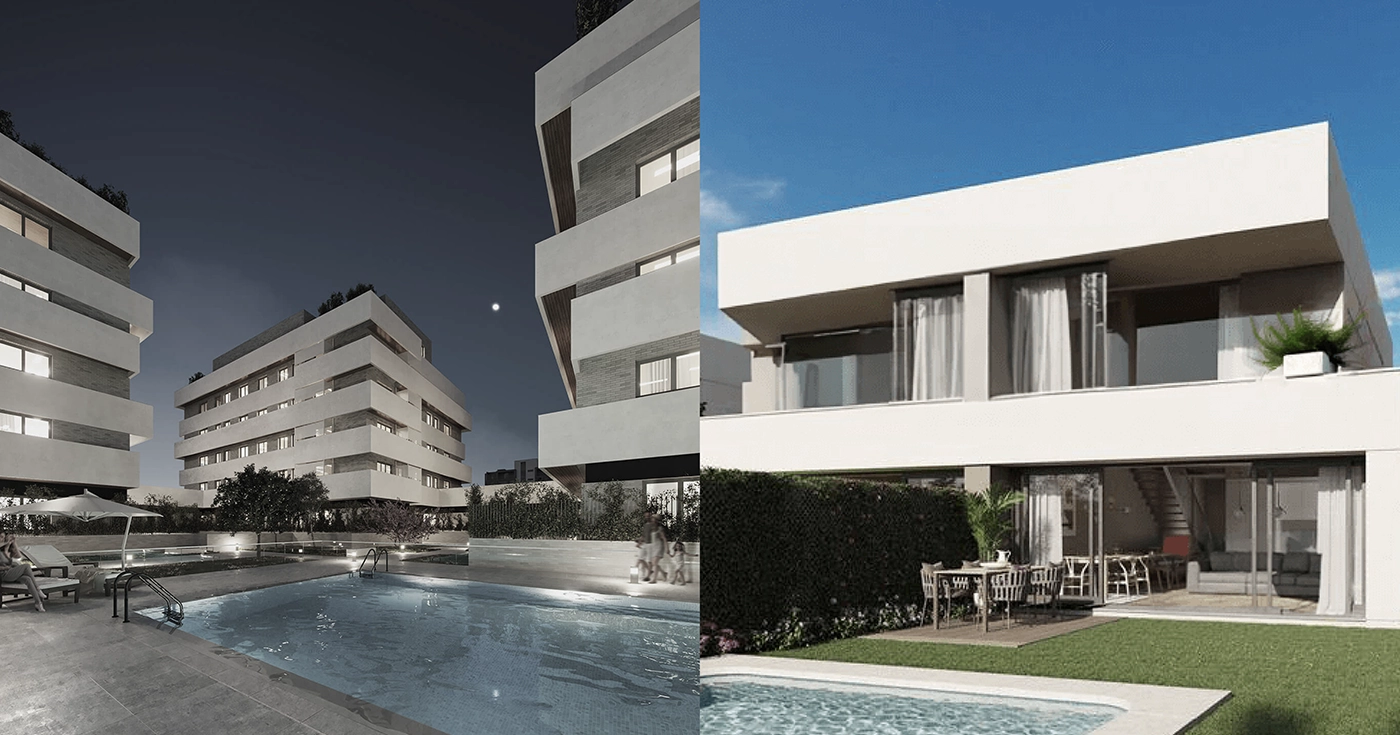
Two repayments delivered as planned: Ribera del Pinar and Los Fresnos close their cycle
Last Updated on 23 January 2026 by Equipo Urbanitae
At Urbanitae, a project repayment is the moment when what truly matters gets confirmed: that the structure, milestones, and monitoring worked as intended from day one. Today we’re sharing two repayments that have evolved as planned, with results consistent with the business plan and timelines within the framework communicated to investors: Ribera del Pinar and Los Fresnos.
Although we bring both repayments together in a single article, these are independent projects, with different dynamics. That’s why we review them separately below: what each one involved and how its closing unfolded.
Ribera del Pinar: protected housing in Navalcarnero
Ribera del Pinar was a debt project designed to finance the purchase of land for a cooperative in Navalcarnero (Madrid), intended for the development of nearly 248 protected homes—specifically VPPL (publicly protected housing with capped prices). The manager was Urbanismo y Gestión, with a track record of more than 4,000 homes delivered.
This nuance matters because VPPL responds to a need that is especially visible in the Madrid market: affordable, family-sized housing. It is, so to speak, a “second tier” within protected housing: it keeps a price cap, but allows larger typologies, designed for households that need more space. In today’s context—marked by a lack of accessible housing supply—this type of product tends to have structurally strong demand.
In the webinar, where all key agents involved in the project participated, it was explained in detail why, even though it was a large-scale development, marketing could be supported by three pillars: pent-up demand in the area of influence, operator experience, and a product with a clear value proposition—quality, square meters, communal areas, and protected pricing.
From the investor’s perspective, the project was structured with a base term of 12 months and a possible 12-month extension. That extension was not a pessimistic Plan B, but a prudent decision: it provided leeway for external factors (administrative timelines, cooperative sign-up pace, banking calendar) without forcing a high-pressure scenario if closing required a few extra weeks. In the end, the extension was activated, although it was not necessary to use it in full.
11.36% IRR return
- Estimated term: 15 months (12 months plus a possible 12-month extension)
- Final term: 15 months
- Estimated CoC: 13.75% (adjusted)
- Final CoC: 13.75%
- Estimated IRR: 11.50%
- Final IRR: 11.36%
In practice, Ribera del Pinar closed within the expected framework, with a consistent final result and no material deviations from the project’s original thesis.
Los Fresnos: plots for self-builders
Los Fresnos was also a debt project, structured as a bridge loan to facilitate the acquisition of land and the necessary work to subdivide it into six plots, with the aim of selling them with permits already in place to end buyers under a self-promotion (self-build) scheme.
The project was located in the Los Fresnos sector (Boadilla del Monte), a well-established area of high-end single-family housing, with good accessibility and nearby services. The strategy relied on a simple idea: in markets where there is demand from self-builders and the product is offered “turnkey” (plot with permit, delegated development contract, and construction at a fixed price), the timeline can be significantly shorter than in a traditional development.
In this case, the project also had a developer—Auric Partners—with experience in this type of operation and specific knowledge of the local market. It was structured with a total term of 12 months, with a possible 6-month extension to cover any reasonable deviation in permit timelines or in the commercial closing of the plots.
10.21% IRR return
- Estimated term: 18 months (12 + 6-month extension)
- Final term: 18 months
- Estimated CoC: 15.75% (adjusted)
- Final CoC: 15.75%
- Estimated IRR: 10.50%
- Final IRR: 10.21%
The repayment of Los Fresnos highlighted the importance of knowing the local market well, working with developers specialized in the asset typology, and structuring operations with guarantees and conservative ratios.
Execution aligned with forecasts
Taken together, the repayments of Ribera del Pinar and Los Fresnos reflect execution aligned with the hypotheses set out from the start. In both cases, the projects developed within reasonable timelines, with final results equal to or better than expected, and with no material incidents in the return of capital.
Two different examples—large-scale protected housing and a smaller residential development—that show how proper structuring, validated demand, and experienced developers can offer visibility and stability to investors even in demanding market contexts.