Category: A Beginner’s Guide to Investing

A Beginner’s Guide to Investing

  • New module: advanced real estate diversification with Urbanitae Academy

    New module: advanced real estate diversification with Urbanitae Academy

    Urbanitae Academy continues to grow. The new Module 2.2 · Advanced Diversification Strategies is now available—an essential part of our Academy’s Advanced Real Estate Investment course with Urbanitae, designed for investors who want to take the next step and start building real estate portfolios with a truly strategic approach.

    Following the release of Module 2.1, focused on advanced project analysis, this new content addresses one of the biggest questions investors face as their portfolio begins to grow: how to combine different projects to balance return, risk, and liquidity over time.

    From choosing projects to building a portfolio

    Module 2.2 starts with a core idea: diversifying isn’t about accumulating investments—it’s about designing a coherent strategy. Throughout the lessons, students learn to see each project not as an isolated decision, but as one piece within a broader portfolio.

    The module is structured around four major levers of investment strategy:

    • Product type (equity and debt)
    • Investment time horizon
    • Risk level based on position in the capital stack and asset type
    • Geographic diversification

    Equity and debt: the two pillars of any real estate portfolio

    One of the first sections dives into the difference between investing as an owner (equity) and investing as a lender (debt). Using real examples, it explains how each format behaves differently in terms of return potential, risk exposure, and timeframe.

    Students learn why equity can offer higher upside, but also greater sensitivity to project performance—and how debt, backed by real collateral, can provide stability, predictability, and faster capital turnover. The key is not choosing one over the other, but knowing how to combine them based on personal objectives.

    Time as a strategic variable

    The module dedicates a full lesson to time horizons, a factor that’s often underestimated. Investing for 12 months isn’t the same as committing capital for four or five years—and that difference directly affects liquidity, risk, and reinvestment capacity.

    It explains how to integrate:

    • Short-term projects, often debt-based, focused on liquidity and capital preservation
    • Medium-term investments that balance value creation and capital rotation
    • Long-term operations, typically equity-based, designed to capture meaningful capital gains

    Learning to stagger maturities helps avoid risk concentration and keeps the portfolio active across different market cycles.

    Diversifying risk beyond location

    Diversification isn’t only geographic. The module introduces key concepts like the capital structure, explaining how the risk profile changes depending on where an investor sits within a project.

    It also reviews different asset types, from residential to commercial real estate, and how they respond differently to economic cycles. Combining assets with less correlated behavior is one of the foundations for building more resilient portfolios.

    An international perspective: investing across markets

    The final section focuses on geographic diversification, an increasingly relevant dimension. The module explains why spreading investments across countries can reduce dependence on a single regulatory framework or economic cycle.

    Spain, Portugal, and France serve as examples of markets with complementary dynamics, where factors like demand, taxation, and institutional stability play different roles.

    Built for investors ready to level up

    As with the rest of Urbanitae Academy, the module combines theory, practical examples, and self-assessment questions to help students lock in the key concepts. The goal isn’t to provide rigid formulas, but to equip investors with solid criteria to make better decisions.

    Module 2.2 is especially aimed at those who have already taken their first steps in real estate investing and now want to think in terms of portfolio design, balance, and long-term strategy.

    With this release, Urbanitae Academy strengthens its training approach: supporting investors not only with access to opportunities, but also with the knowledge needed to invest with discipline, sound judgment, and a bigger-picture view.


  • Key concepts every investor should master at the start of the year

    Key concepts every investor should master at the start of the year

    Starting the year by thinking about how to invest better is a smart move, but doing it without a solid foundation often leads to major mistakes. In investing—and especially in real estate investing—it’s not enough to spot attractive opportunities: it’s essential to understand what’s behind the numbers, the timelines, and the risks you’re taking on.

    Mastering basic concepts doesn’t turn anyone into an expert overnight, but it does make the difference between investing with sound judgment or investing based on trends or other people’s recommendations. Financial education starts with clearly understanding the fundamentals on which any investment strategy is built, so in this article we’ll help you grasp certain criteria before you begin.

    Return: what it is and how to interpret it correctly

    Return is one of the first concepts that catches the attention of new investors, but it’s also one of the most misunderstood. In simple terms, it measures how much an investment earns in relation to the capital invested, usually expressed as a percentage.

    The common mistake is focusing only on the number without analyzing how it’s achieved. A high return can hide significant risks, unstable income, or overly optimistic assumptions. That’s why interpreting return correctly means asking where it comes from, over what time period it’s achieved, and what variables could make it change. Not all returns are comparable, and not all of them fit every investor profile.

    Risk: understand it before you take it on

    Every investment involves risk. Even options perceived as “safe” have it, even if it takes less obvious forms. Risk is not only the possibility of losing money, but also the uncertainty about when and how the expected results will be obtained.

    In real estate investing, risk can come from many factors: changes in demand, unexpected costs, liquidity problems, or excessive dependence on financing. Understanding risk before accepting it means being aware of possible negative scenarios and assessing whether you’re willing—and able—to handle them without jeopardizing your overall wealth.

    Time horizon and liquidity: when and how you’ll recover your investment

    Two closely related and often overlooked concepts are time horizon and liquidity. The time horizon refers to the investment’s time frame, meaning how long it takes for the strategy to play out. Liquidity indicates how easily an investment can be converted into cash.

    In real estate, time horizons tend to be long and liquidity limited. This isn’t necessarily negative, but it does require planning. Investing without being clear on when you can recover your capital—or without a buffer for unforeseen events—can create unnecessary stress.

    Diversification: don’t put all your eggs in one basket

    Diversification is one of the most repeated principles in investing because it works. It means spreading capital across different investments to reduce the negative impact if one of them doesn’t perform as expected.

    In real estate investing, diversifying doesn’t only mean buying multiple properties. It can also mean diversifying by asset type, location, time horizon, or even the way you access the market. A well-diversified portfolio doesn’t eliminate risk, but it makes it more manageable and predictable over time.

    Gross return vs. net return

    Another key concept to avoid mistakes is distinguishing between gross return and net return. Gross return is calculated before expenses, taxes, and associated costs, while net return reflects what actually ends up in the investor’s pocket.

    In real estate, maintenance costs, taxes, vacancy periods, or financing costs can significantly reduce the initial estimated return. That’s why any serious analysis should always focus on net return rather than attractive but incomplete figures.

    Conclusion: learn the concepts before investing money

    Starting the year by strengthening your basic investment knowledge is one of the best financial decisions you can make. Return, risk, time horizon, liquidity, diversification, and strategy are not theoretical terms: they’re practical tools that help you invest with better judgment and less frustration. What we need to be clear about is that before investing money, you need to invest time in learning these concepts.

    Investing without a strategy is one of the most common mistakes among beginners. An investment strategy defines what you’re aiming for, over what time horizon, with what level of risk, and through which types of assets. Without that framework, it’s easy to make impulsive or contradictory decisions.

    In real estate investing, a clear strategy helps you filter opportunities, say “no” to investments that don’t fit, and maintain discipline when the market changes. It’s not about predicting the future, but about having a coherent plan that guides decisions over time.

  • How to Start Investing: 7 Steps to Do It Safely

    How to Start Investing: 7 Steps to Do It Safely

    Starting to invest has never been so accessible: mobile apps, real-time information, and an endless range of financial products have democratized access to saving and investing. However, this ease also carries a risk: overexposure to superficial information, passing trends, and unrealistic expectations.

    The difference in 2025 lies not just in what to invest in, but in how. Current conditions—still-high inflation in Europe, interest rates in the process of adjustment, and tense real estate markets in major cities—require new investors to adopt a more strategic vision and explore more accessible options.

    The 7 Key Aspects Before Investing

    1. Define Your Goals Clearly

    Investing for retirement is not the same as saving to buy a house in five years. Before moving a euro, set timelines and objectives. This step determines your risk tolerance and which products are most suitable.

    2. Understand the Risk-Return Tradeoff

    A common beginner mistake is focusing only on returns. Risk is the other side of the coin: higher potential returns come with higher volatility. The key is finding a balance that fits your profile.

    3. Build a Liquidity Cushion

    Investing without an emergency fund is like sailing without a life jacket. A minimum cushion of three to six months of expenses allows you to invest without fear of starting over in a bad moment.

    4. Diversify Beyond the Obvious

    Diversification isn’t just about holding shares of multiple companies or different funds. It also means diversifying across geographies, sectors, and asset types. Today, access to alternative assets like real estate crowdfunding allows small investors to participate in projects that were previously reserved for large capital.

    5. Know the Hidden Costs

    Fees, taxes, management expenses… 1% per year may seem small, but over time it significantly erodes returns. Carefully analyzing costs is part of smart investing.

    6. Avoid Market “Noise”

    Too much information can be as dangerous as too little. Daily news, social media rumors, or short-term market moves can lead to impulsive decisions. The key is to separate signal from noise and rely on trustworthy sources.

    7. Invest in What You Understand

    Interest in new technologies or cryptocurrencies can be tempting, but if you don’t understand how they work, you shouldn’t invest in them. Investing requires knowledge, not blind faith or following the success of others.

    Investment Options for Beginners in 2025

    Three paths are especially interesting for newcomers:

    • Index Funds and ETFs: accessible, diversified, and low-cost. Check this guide to help you get started.
    • Real Estate Crowdfunding: selected projects that allow participation with small amounts in the real estate sector, traditionally a safe haven in uncertain times, through trusted platforms like Urbanitae.
    • Inflation-Linked Bonds: products that gain relevance in a rising price environment.

    Conclusion

    Investing from scratch in 2025 requires more than just downloading an app, clicking, or reading on X about the latest trends making others rich. It means having a plan, understanding risks, and leveraging new market alternatives, like collective real estate investment, always adapted to your situation.

    The best advice for beginners is to start decisively, with clear goals and a long-term mindset. In investing, more than speed, consistency and knowledge are what truly matter.

  • 8. Real estate crowdfunding: what it is and why to invest

    8. Real estate crowdfunding: what it is and why to invest

    At Urbanitae, we are dedicated to it, so it seems appropriate that we explain in this blog what real estate crowdfunding is and why it is an interesting investment alternative.

    What is real estate crowdfunding?

    The basic idea behind crowdfunding couldn’t be simpler: getting many people to collaborate on a project. The concept is as old as the saying “Strength in numbers”, and in fact, one of the clearest precedents of crowdfunding dates back to the late 19th century. Do you remember the Statue of Liberty? Well, it required a collective fundraising effort in which more than 100,000 people participated. Pure crowdfunding.

    So we can define real estate crowdfunding as a form of collective financing that allows a diverse group of people (investors) to fund real estate projects through digital platforms, such as Urbanitae. These platforms connect real estate developers seeking funding for their projects with investors looking to diversify their portfolios without committing large sums of money.

    Real estate crowdfunding, also known as real estate crowdfundization or real estate crowdfunding, is a form of collective financing that allows a diverse group of investors to fund real estate projects through digital platforms. These platforms bring together real estate developers seeking financing and investors looking to diversify their portfolios without the need for substantial sums of money.

    How it works

    It is increasingly common for real estate developers to turn to alternative sources of funding rather than traditional banks. There are several reasons for this. Since the 2008 financial crisis, banks have limited their exposure to the real estate sector and have almost ruled out financing land. Furthermore, due to the new mortgage law in 2019, it is not as profitable for them to finance new construction, as they do not automatically retain the mortgages of the buyers.

    Therefore, real estate crowdfunding platforms represent an efficient and reliable alternative to finance projects of up to five million euros (the maximum allowed by the law). In the case of Urbanitae, the capital we raise is typically used to finance the purchase of the land for the project or to start construction until obtaining the developer loan. We also offer our own developer loan model.

    In the case of Urbanitae, the majority of projects are residential in nature, although we are open to any segment with good opportunities. We select projects based on various criteria, but we mainly look at the capacity and track record of the developer, the commercial progress of the project, and the status of the building permit. Additionally, the decision is subject to review by an investment committee with external experts.

    There are two main types of projects: debt-based projects (real estate crowdlending) and equity-based projects (equity crowdfunding). In the first case, investors pool their money to lend to the developer, typically in the form of a fixed-rate loan. Once the term is met, the developer repays the money, and investors recoup their investment along with the corresponding returns.

    In equity-based projects, investors enter into a partnership with the developer, sharing both the project’s risks and the generated returns, typically around 15% annually. In this case, there is no predetermined term, but rather an estimate, as there may be delays in marketing, obtaining permits, or increases in construction costs. In Urbanitae, the majority of projects fall into the equity category.

    Regulation of real estate crowdfunding

    Real estate crowdfunding platforms have been regulated in Spain since 2015 by Title V of Law 5/2015. In October 2020, the European Union approved a regulation to unify the rules applicable to crowdfunding platforms at the European level, Regulation (EU) 2020/1503. This regulation has been in effect in Spain since November 10, 2021, although platforms have until November 10, 2023, to adapt to it. In Spain, Law 18/2022 is the one that aligns Spanish legislation with the legal framework established at the European level.

    Furthermore, crowdfunding platforms are supervised by the National Securities Market Commission (CNMV) in Spain and, at the European level, by the European Securities and Markets Authority (ESMA).

    Why invest: advantages and disadvantages

    We have already discussed the advantages of investing in real estate crowdfunding in the blog. The first is that it allows access to very attractive investment opportunities with small amounts of money, as low as 500 euros. This enables many investors to diversify their portfolios by including a stable and inflation-resistant sector like real estate, without the hassle of management or property purchases. And of course, the return on investment, which is significantly higher than investing in residential properties. In the case of Urbanitae, it averages around 17% annually.

    Among the main disadvantages, it’s important to note that it’s an illiquid investment, meaning you can’t divest from it until the project is completed. Another possible drawback is the time frame, which typically averages around 24 months. Additionally, like any investment, real estate crowdfunding is not without risks; despite all precautions, an investor could potentially lose their capital.

    In summary, real estate crowdfunding has revolutionized how people invest in real estate, democratizing access to quality investment opportunities. Although it has both advantages and disadvantages, its continued growth indicates that it is a trend that is here to stay and is on the rise. Have you tried investing in real estate crowdfunding yet?

  • How to invest in real estate in Spain in 2025

    How to invest in real estate in Spain in 2025

    If you’ve decided to invest in real estate – and there are good reasons to do so – it’s essential to know that there are two major possible strategies. In this article, we’ll explain what active and passive real estate investment entails, how these concepts relate, and which one might be the best option for your financial goals.

    But first, some interesting facts:

    1. In 2025, real estate investment in Spain is expected to grow by between 10% and 15%, according to CBRE.
    2. July 2025 marked a historic record for home sales in that month, as noted by the INE

    The distinction between active and passive management is common when discussing investment funds. In the world of investment funds, active management involves active decision-making by professional fund managers with the goal of outperforming the market. These managers actively select and adjust investments in the portfolio, which often results in higher management fees.

    On the other hand, passive management seeks to replicate the market’s performance and minimize costs by investing in a diversified portfolio of assets, such as stock indices, rather than making active decisions. This strategy tends to be more cost-effective for investors and has consistently shown to outperform active management in terms of net returns after fees.

    But how do these differences apply to real estate investment?

    Active Real Estate investment

    In the real estate sector, active investment resembles the active management of funds, where investors make decisions and manage properties directly. In contrast, passive investment relates to investment strategies in diversified real estate vehicles or collective projects, similar to passive fund management. Essentially, there are three ways to actively invest in the real estate sector:

    • Property rental: In this approach, investors acquire properties, such as apartments or houses, with the aim of renting them out. As prices and rents increase over time, this strategy can provide passive income.
    • Property flipping: The “house flipping” strategy adds an extra twist to active real estate investment. It involves buying distressed properties, renovating them, and selling them quickly for a profit. However, it requires in-depth market knowledge and a significant initial investment.
    • Real Estate trading: This strategy entails buying properties with the intention of selling them at a higher price in the future, capitalizing on the increase in real estate market value.

    Active real estate investment offers interesting advantages: it provides greater control over investment decisions and property management and has significant profit potential if done correctly. However, as mentioned, the main disadvantages are the costs and the level of knowledge and dedication required from the investor.

    Passive Real Estate investment

    In contrast, passive real estate investment resembles passive fund management. Investors do not directly participate in property management but rely on professionals or engage in collective investment vehicles. In this case, there are three major ways to carry out passive real estate investment:

    • Real Estate investment funds: These funds specialize in the real estate sector and generate returns through dividends or the sale of shares.
    • Real Estate Investment Trusts (REITs): Publicly-traded Real Estate Investment Trusts operate in the stock market and acquire, develop, and manage real estate assets.
    • Real Estate crowdfunding: Real estate crowdfunding brings together multiple investors to finance real estate projects. It is an accessible option with controlled risk. You can read more in our article on real estate crowdfunding.

    Among the key advantages of passive real estate investment are the following:

    • Reduced Time Commitment: It requires less time and management effort, allowing you to diversify your portfolio.
    • Automated Diversification: You can invest in a variety of real estate assets without directly managing the properties.

    The primary drawback of this form of real estate investment is reduced control: similar to passive fund management, you cede direct control over properties to third parties.

    Active or passive investment?

    The choice between active and passive real estate investment will depend on your goals, resources, and preferences. Active investment offers greater control and profit potential but also demands a time commitment and expertise. On the other hand, passive investment is less demanding in terms of time and effort but involves reduced control.

    It’s important to recognize that passive real estate investment provides options for a wide range of investors, from those with ample knowledge and resources to those seeking a more accessible entry into the real estate market. The choice between the two depends on your personal profile and goals.

    The key is to understand the differences and select the strategy that best suits your needs. As an investor, you can explore various options and, as mentioned in the video, consider real estate crowdfunding as an intriguing way to diversify your portfolio and access real estate investment opportunities. Whatever you decide, diversification remains a fundamental pillar for success in the world of real estate investment. Invest wisely!

  • 6. 7 reasons why real estate investment is the best option

    6. 7 reasons why real estate investment is the best option

    No one would invest if they didn’t expect to make a profit. But potential returns are often not the only criterion. For many savers, peace of mind is just as important as returns. In other words, maintaining a controlled level of risk. Real estate has always been considered a safe haven precisely for that reason, combining an attractive return with a reasonable degree of risk. In this article, we explain why real estate investment can be the best option to invest in.

    It provides stable income

    One of the main advantages of investing in real estate is the generation of stable income through rentals. By acquiring a rental property, you can receive regular payments from tenants, which is a reliable source of cash on a month-to-month basis. This income is usually enough to cover property-related expenses and generate profits for the investor.

    It protects against inflation

    Real estate has the ability to protect against inflation. As prices of goods and services rise with inflation, so do property prices and rental income. This means that the value of the real estate investment and the income generated tends to increase in line with inflation, which helps maintain the investor’s purchasing power.

    It allows portfolio diversification

    We have already talked on the blog about the benefits of diversification. Many experts consider real estate to be a good way to complement traditional fund investments. By adding real estate to a portfolio that already includes stocks, bonds or other assets, the correlation between different assets can be reduced. This means that if one sector experiences underperformance, other assets can compensate for those losses. Diversification helps mitigate risk and balance potential returns.

    It increases your wealth

    Investing in real estate can increase your wealth in several ways. If you have taken out a mortgage to buy an apartment and rent it out, as you pay off that mortgage, your debt decreases and your net worth grows. In addition, the value of that property usually increases over time due to the appreciation of the real estate market and the improvements and renovations you make to it. This means that your net worth can increase as the property appreciates.

    A stable and tangible investment

    You know what we say around here: invest in something you can touch. Unlike alternative investments like startup stocks or cryptocurrencies, real estate investing offers stability and tangibility. Real estate is physical property that exists in the real world and has intrinsic value. This often provides a greater sense of security and control for investors.

    It offers tax benefits

    Real estate investment offers some tax benefits. Owners of a rental property can deduct property-related expenses and achieve annual depreciation deductions. In Spain, if the rented property is the tenant’s habitual residence, the applicable yield can be reduced by 60%: that is, taxes can be paid on only 40% of the yield obtained.

    It allows to obtain capital gains

    In addition to the income generated by renting, real estate investment also offers the potential for long-term capital gains. What does this mean? That, as the value of the property increases over time, real estate investors can take advantage of the rising price and sell the property for more money than they paid at the beginning.

    If you think real estate investing is the best option but you’re not in a position to buy property, no problem. Through real estate crowdfunding investment you can access many of the advantages of real estate investment without the worries of having to manage a property, and without paperwork of any kind. With Urbanitae, you can invest in real estate developments throughout Spain from only 500 euros. Without expenses or commissions, and in a 100% online way. If all this sounds good to you, take a look at the Urbanitae website, it’s free!

  • 5. Alternative investments: all you need to know

    5. Alternative investments: all you need to know

    Admittedly, the word “alternative” adds an interesting twist to just about anything. Think of alternative realities, which have given rise to fiction classics, such as Alice in Wonderland. Or in music, with the rise of mythical bands like R.E.M. or Nirvana. Although sometimes the nuance is rather disturbing, as is the case with alternative medicine… What about alternative investments?

    When we talk about investment, the traditional assets are stocks, bonds and cash. People tend to invest in the first two through funds. And in the second, through bank deposits. So everything else is alternative investments. From cryptocurrencies to bricks and mortar to artwork and expensive wines, these are all alternative investments.

    And you might ask: what’s the point of investing in precious metals, art or hedge funds? For returns, of course. But more to the point, alternative investments offer a somewhat more sophisticated form of diversification. For a start, because they often involve exclusive investment opportunities: not everyone can invest in Picassos. And also because they have a low correlation with the markets.

    Advantages of alternative investments

    As we know, diversification helps to reduce risk and also to increase the profitability of the investment portfolio. Low correlation with the markets is another main advantage of alternative investments. But there is more:

    • Higher potential returns: alternative investments often have higher potential returns compared to conventional investments. They are more complex and have more risk, so returns can be higher.
    • Lower volatility: Because they are generally not subject to market fluctuations and have a longer investment time horizon, alternative investments are often more stable, for example, than stocks. Although some, such as cryptocurrencies, have experienced large variations in value.
    • Access to exclusive assets: Unfortunately, few of us have access to works of art or luxury yachts. Such exclusive assets can have significant value and thus provide a unique investment opportunity.

    Disadvantages of alternative investments

    Advantages and disadvantages are often flip sides of the same coin. For example, the higher potential return has to be weighed against higher risk and more complexity. Uniqueness has the small problem of cost: many alternative investments require much more money than most people could devote to them. There are other disadvantages:

    • Lack of regulation: some alternative investments are unregulated and may be subject to greater risk of fraud or manipulation. In some cases, such as the Bernie Madoff or Theranos scandal, with serious damage to participants…
    • Less liquidity: It is all very well to have a Romanée-Conti in the cellar: some bottles from this producer have been auctioned for half a million dollars. But it’s not easy – or quick – to turn them into cash… or to find buyers.

    Fortunately, there are somewhat more affordable alternative investments. For example, you can invest in commodities or precious metals through mutual funds. With a clear understanding of the risk, it is possible to invest in cryptocurrencies without allocating large amounts. And real estate crowdfunding allows anyone to invest in real estate with little money. In Urbanitae, from only 500 euros. And with a very attractive combination of risk and profitability. And you? Have you already tried it?

  • 4. How and where to invest

    4. How and where to invest

    If you have already checked that your financial house is in order and you already know what you want to achieve with your investments and when, it remains to be asked: what exactly do I invest in? And it is not the same to allocate your savings to buy NFT of the works of Damien Hirst than to put them in Treasury Bills. Luckily, there are many investment options. In order not to mess up, we will simplify a little.

    There are two main types of assets to invest in: traditional assets and alternative assets. Broadly speaking, traditional assets include stocks and bonds. On the other hand, within alternative assets we find two basic assets: raw materials and real estate. Indeed, things as lifelong as brick or gold are alternative assets. And pretty safe, besides.

    Let’s start with the first ones. You may have suspected that stocks and bonds are all about the stock market, and you’re right. As you know, shares are shares in the capital of a company (which is also called equity). Companies issue shares to finance themselves; Investors buy shares to earn returns on them: specifically, their proportional share of the company’s profits and dividends. If it does, of course. We also often call all this equities, because their value changes – sometimes drastically – and is traded daily in the market.

    Bonds are fixed-income securities. They are called that because they are like a fixed-rate loan. When a company or a government needs financing, it can issue bonds. After the term, the company or the government repays that loan with the interest set above. It is common that, while the bond is in force, the investor receives periodic interest – as in an income project. This periodic dividend is often called a coupon.

    The Stock Exchange and the Funds

    If we are guided by the movies, investing in stocks has to do with individuals in suits frantically telephoning from the parquets. Nowadays investing in the stock market is simpler and cheaper. You can buy shares from home through your bank or an online broker. (The men in suits I was referring to were the only brokers there before…).

    The bad thing is that choosing stocks is a complicated task. It requires a lot of dedication – you have to be aware of the current situation of companies – and the results are discreet. The reality shown is that the best path to profitability is not to choose at all. That is, invest not in a handful of companies, but in all those listed on the Stock Exchange. It is the best way to diversify your investment: this way, when some stocks go wrong you can compensate for the risk with those that go well.

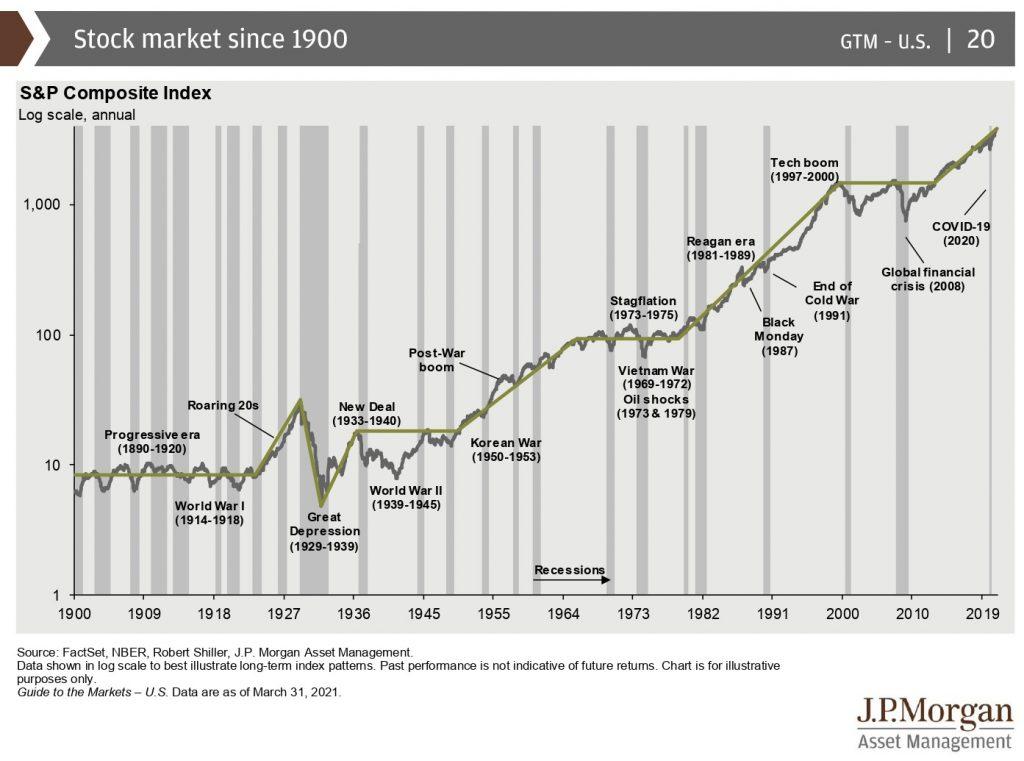
    That’s what index funds do. Instead of trying to beat the market – choosing the best stocks – they are content to replicate it. They invest in an entire index, for example, the S&P 500 or the IBEX 35. It is much simpler, it is also cheaper and, above all, it works. Why? Because the market always wins. Despite the crises, in the long term all stock markets rise and the economy grows.

    Behavior of the S&P 500 index since 1900

    The example of the S&P 500, seen on the chart, makes this clear. As John Bogle, considered the inventor of the index fund, advises: “Just buy the entire stock market. Then, once you’ve bought your shares, exit the casino and stay out. Stick to keeping the market portfolio forever. And that’s what the index fund does.”

    These funds are passively managed: the actively managed ones are run by experts who make the stock selection for you, trying to beat market performance. However, beating the market is within reach of very few. “Over 10-year periods,” Burton Malkiel and Charles Ellis explain, “equity investment funds have repeatedly outperformed two-thirds or more of actively managed funds.” And with a much lower cost.

    Alternative investment according to Urbanitae

    Funds are also the easiest way to invest in alternative assets such as commodities, such as oil; base metals, such as iron or nickel, and precious metals, such as gold or silver. These assets are normally considered a haven against inflation and are a good way to diversify. But their operation is not so simple and they can experience volatility when there are geopolitical tensions – as now.

    Therefore, the most appropriate option to start in alternative investment is the brick. We have already told you in the blog how you can invest in real estate. One of the most comfortable options for the investor is real estate crowdfunding. Proposals such as Urbanitae’s also combine the two approaches of the funds, passive and active management. There is a team of experts who filter and select the projects that are uploaded to the platform, but it is the investor who ultimately decides which ones he wants to invest in. And at no cost… Do you dare to try?

  • 3. How to plan investments well

    3. How to plan investments well

    We already know that starting to invest has the advantage that the best time is now. But that doesn’t mean we should rush. Nor take unnecessary risks. In this series of posts about investment, our first objective is clear: not to screw up. Therefore, we focus more on the foundations, the things that we must be clear about before committing our money.

    One of those things is what we want to achieve with our investment. Probably the person who invests in Bitcoin does not do it to ensure a quiet retirement. Their goal is different. Nor will a person who is looking for a house to buy behave the same as one who already has it or lives in rent. Nor will a 25-year-old take into account the same things as a 65-year-old.

    That’s why it’s essential to know where we start from – and to get our finances in order. Having our investment objectives clear will also help us make better decisions. For example, if we are investing with a 20-year horizon – because we know that the long term is our friend – we will be more patient when things go less well. And we will not divest lightly, nor will we give up potential future profits.

    Planning investments well is not just a matter of risk. It is to have a margin of safety. There is no closed definition, but, in essence, it is about having “an austere budget, a flexible mindset or a lax chronology” that, as Morgan Housel explains, “allows you to live happily with a wide variety of results.” That is, a framework that increases our chances of succeeding with the level of risk we have previously set.

    The Rule of 72

    It is not always easy to calculate the foreseeable or estimated result of our investments. Therefore, when planning it is useful to use the so-called rule of 72. This formula allows us to estimate how long, in years, it will take for our investment to double. Mind you, the rule of 72 is an approximation, not a mathematical law:

    The rule of 72 is a formula that can help you plan investments well

    This is the famous rule of ’72.

    Imagine that we invest 1,000 euros in a product whose annual return is 4%. To estimate when those 1,000 euros will have become 2,000, it would be enough to divide 72 by 4 (the amount invested is not relevant). So if we want to double our money with that product we must maintain our investment in that product for 18 years.

    This rule could also be used, with caution, to estimate the impact of inflation on our savings. In this case, we would try to find out how long it would take our money to divide between two: that is, to lose half of its value. The operation, in this case, would be somewhat different. 72 would have to be divided by the annual rate of inflation. For inflation of 4%, the result would also be 18 years. It is very approximate, since it is rare for inflation to be so stable for so long. But it serves to give us an idea.

    Autonomy and financial freedom

    Another way to approach our planning is to think in terms of financial freedom. That is, the degree of dependence or autonomy we have with respect to our salary. I’ll put it another way. It is assumed that full financial freedom is achieved when one can live on rents, that is, one does not need to work to obtain the income he needs to lead the life he wants to lead.

    Perhaps it is a goal within the reach of a few. That is why we also talk about autonomy or financial independence. The idea is always the same, to see how we can balance our recurring income (payroll) and additional income (rental income, dividends, capital gains …). Investment is a good way to increase additional income and, therefore, improve our financial independence.

    For example, in Urbanitae we offer you the possibility of obtaining periodic income with our new line of assets in profitability. It’s one more idea you can take a look at. Do the math and ask us what you want. That’s what we’re for…

  • 2. The basic rules of investing

    2. The basic rules of investing

    As in many other areas of life, good investing involves a significant part of avoiding mistakes. These four basic rules of investing will help you avoid stumbling more than necessary.

    The first thing to clarify is that the aim of these rules is not to get rich, but to avoid losing your money. Following these recommendations will allow you to make more informed investment decisions… and save you from unpleasant surprises.

    As we’ve already told you, the first requirement to start investing is to have saved money and have your financial house in order. From there, decisions depend on each investor’s profile and the risk we want to take. And risk is closely linked to the stage of life we are in. Surely, we won’t want to invest the same way if we’re thinking of buying a flat or if we want to strengthen our retirement

    In any case, general recommendations suggest saving around 10% of your salary and investing about 10% or 15% of your income. This percentage could increase to 30% or 40% depending on what we mentioned: the stage of life and each person’s risk tolerance. However, the basic rules of investing apply to all investors. Here they are:

    1. Start early

    The saying “don’t put off until tomorrow what you can do today” also applies to investing. In fact, if you haven’t started yet, you’re in luck because now is always the best time. Unless your goal is to get returns in a short time. For most investors, it’s never too late, because, in the long run, the market always grows. And because returns, however small, multiply your savings over time.

    We’ve already talked to you about compound interest. Initially, interest makes your investment grow a little, but then that interest is applied to the slightly larger total. Consequently, the growth of your savings is not arithmetic, but geometric. To give you an idea: imagine you put 1,000 euros in a piggy bank and add 30 euros each month. After 20 years, you would have 8,200 euros. If instead of the piggy bank, you chose a deposit at 2%, in the 20th year you would have 10,400 euros. After 30 years, it would be 16,700…

    2. Think long term

    The economy has its cycles. Normally, if it has been growing for a long time, there will come a time when it stops and enters a recession – well, unless you live in Australia. This affects the valuation of assets – those in which you can invest – although its effect is not uniform. Additionally, there may be complications in one sector but not in others. In short, it’s difficult to beat the market: to predict what will happen to take advantage.

    What doesn’t change is that the market, like the economy, always grows in the long term. Hence, it’s never too late to start investing – without being carried away by euphoria or the decisions of other investors. As Warren Buffett said, “To make money in investing, you need to buy good companies and hold them for long periods of time.” Of course, the first part is easier when you’re Warren Buffett…

    3. Diversify

    Ray Dalio, founder of the hedge fund Bridgewater Associates and considered one of the most influential people in the world, states that diversification is the “holy grail” of investing. The key to success is simple: “Find 15 or 20 good sources of income that are not correlated with each other.” Again, the experience of being Ray Dalio counts for a lot.

    But the idea is clear. If we invest in different assets, different sectors, different countries, or at different times, we dilute the risk. Urbanitae’s proposal is based on diversification: starting with small amounts, it allows investing in a variety of independent projects and diversifying by type of asset and location.

    4. Make sure you understand it

    Even the most classic investment options deserve a careful examination. If you have doubts between TIN and TAE, don’t know exactly what a coupon bond is or the difference between gross and net return, ask before deciding. And make sure to invest in something you can understand how it works. Part of the disaster that occurred during the Great Recession – the global crisis that started in 2007 – was that many invested in products – derivatives – like CDS or CDO, which were hard to untangle.

    In summary, don’t get carried away or make hasty decisions. And choose investments that you can explain to your parents… or that you can touch.

  • 1. Why you need to save before you invest

    1. Why you need to save before you invest

    It’s always a good time to start investing. However, before taking that step, it’s essential to ensure you have a solid financial foundation. Saving before investing not only provides financial security but also maximizes the potential of your investments. In this first article of our guide, we explain why the correct order of steps is: first, saving; second, investing.

    Imagine your personal finances as a house. The most important thing is that this house has a solid foundation capable of withstanding economic storms.

    1. The emergency fund

    The problem with unforeseen events is that you never know when they will occur… That’s why the first rule is to have an emergency fund, which acts as the foundation of our financial house. The emergency fund acts as a financial safety net, covering unexpected expenses such as car repairs, medical emergencies, or job loss.

    This fund should have enough money to cover three to six months of expenses and be easily accessible. The ideal amount saved will depend on your circumstances: it won’t be the same for a single person as for someone with children or dependents. Having an emergency fund gives you the peace of mind that you won’t need to sell your investments during tough times, thus protecting your portfolio in the long run.

    2. Salary and other regular income

    The next level of our house consists of regular income. These are the predictable and steady income streams you receive, whether from your job, pensions, rentals, or any other constant source of income. This level is crucial because it provides the cash flow necessary to cover your monthly expenses, save, and invest. Efficient management of this income is vital to maintaining financial stability and ensuring you can continue building your financial house.

    3. Short-term savings

    Higher up, with a view of the street, are our short-term savings. These are funds set aside for specific, relatively near-term goals, such as vacations, purchasing an appliance, or any planned expense you expect to incur in the next one to three years. For example, replacing that cracked phone screen that looks like a kaleidoscope.

    Having these short-term savings allows you to manage planned expenses without dipping into your emergency fund or going into debt, keeping your finances organized and under control.

    4. Insurance

    According to the Centers for Disease Control and Prevention (CDC) in the United States, the odds of being struck by lightning are 1 in 500,000. It’s unlikely to happen to us, but we still sleep with a roof over our heads. In our financial house, that roof represents insurance, which protects us and our families from things we can’t fight against.

    Indeed, insurance provides protection against significant risks that could have a devastating impact on your finances. We’re talking about health insurance, life insurance, home insurance, car insurance… Having adequate insurance coverage is fundamental to ensuring financial stability and security.

    5. Debt-free

    Finally, we have the chimney. It’s not that we’re insensitive to greenhouse gas emissions: it’s just an analogy. The smoke from the chimney represents the debt we are reducing, such as car payments or the mortgage. Especially short-term debt, which typically carries higher interest rates. (Compound interest works wonders with money. When it comes to returns, it’s great, but when it comes to debt, it can be disastrous).

    The smoke from the chimney indicates that while there are financial commitments, they are under control and actively being reduced. Consistently paying off debt not only frees up resources for other areas of your financial life but also improves your credit score and reduces financial stress. Keeping debt under control is essential to prevent it from consuming your income and savings.

    If you want to learn more about investing, visit our Learn section on the blog and our YouTube profile.