E-commerce is experiencing historic growth in Europe and Spain, driven by the boom of ultra fast fashion platforms such as Shein and Temu. These companies have multiplied their revenue in just a few years—from $6 billion in 2022 to $44 billion in 2024—thanks to a business model based on competitive prices, massive catalogs, and rapid deliveries. This approach is reshaping international logistics and fueling demand for distribution centers and industrial land in key markets, including Spain.
A Property Market Under Pressure
According to the European E-commerce Report 2024, European e-commerce reached €887 billion in 2023, up 3% from the previous year. This growth is reflected in a higher number of digital shoppers: 71% of Europe’s population made online purchases last year. Spain follows the same trend, with 68% of the population aged 16 to 74 regularly shopping online. This shift in consumer habits has had a direct impact on the logistics market, as online channels require three times more space than traditional retail distribution, due to larger stock volumes, reverse logistics, and the need to be closer to the end consumer.
However, the availability of logistics space is at historic lows. In Barcelona, only 1%-2.5% of prime land is available, while Madrid shows a 10.4% rate with sharp differences between submarkets. This shortage has pushed rental prices in the most in-demand logistics zones up to €6.25 per square meter, representing a 5% year-on-year increase and 1.6% compared to the first quarter of 2025.
At the European level, the Prologis Logistics Rent Index shows that logistics rents grew by 7.2% in 2021, the latest available data, with peaks of 13% in the UK and over 10% in major German markets. Meanwhile, the cost of additional land rose by 40% and construction costs by 18% in Europe.
Investment Opportunities in Spain’s Logistics Sector
The demand for more logistics space is creating highly attractive real estate opportunities for investors. In this regard, Savills highlights that logistics leasing volume reached 690,000 square meters in the first quarter of 2025, largely driven by pre-lease agreements and build-to-suit projects.
These opportunities are concentrated on two fronts: prime assets in high-demand areas, such as the Barcelona metropolitan area or the A-2 corridor in Madrid, where availability is minimal and rental pressure is highest; and emerging zones with growth potential, such as southern Madrid or port areas in Valencia, Sagunto, and Algeciras, which are gaining prominence as new strategic logistics hubs. This is largely fueled by the rise of Chinese companies, whose distribution model requires infrastructure capable of handling massive volumes of goods.
In this context, investment capital is responding to the trend, consolidating the industrial and logistics sector as one of the most attractive, with €1.11 billion in investment in 2024—an 87.9% increase compared to the previous year.
Regulatory Challenges and New Dynamics in European Logistics
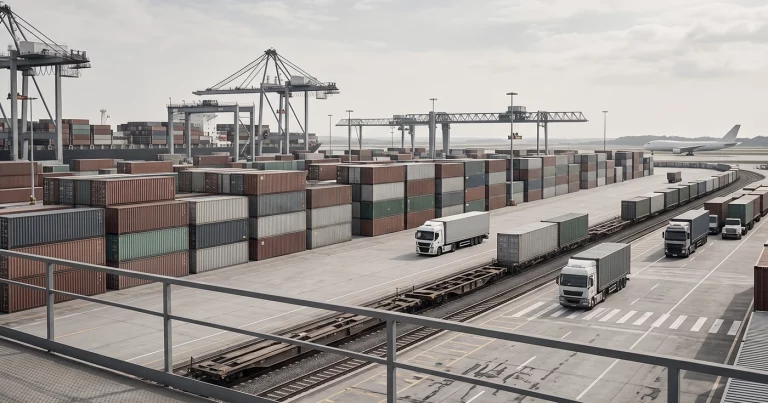
The logistics sector faces several challenges and trends that will shape its development in the coming years. One of the most significant is the interconnection of logistics infrastructure, as the integration of ports, airports, and railway networks is seen as a key strategy to optimize costs and delivery times.
In addition, European regulation could undergo a major change in the coming months, as the European Commission (EC) has proposed eliminating the de minimis tariff exemption, which currently allows imports of products under €150 without duties. This measure—directly impacting platforms such as Shein or Temu, who benefit most from the current system—aims to curb the massive influx of low-value parcels entering the EU each year: more than 4.6 billion, according to EC data.
If approved, this proposal would significantly reshape international logistics flows: many companies would need to redesign their entry routes into Europe, and part of air transport could shift to maritime routes. In that case, Spanish ports would take on a strategic role, boosting the development of new logistics facilities in their surroundings and strengthening their position in the global supply chain.