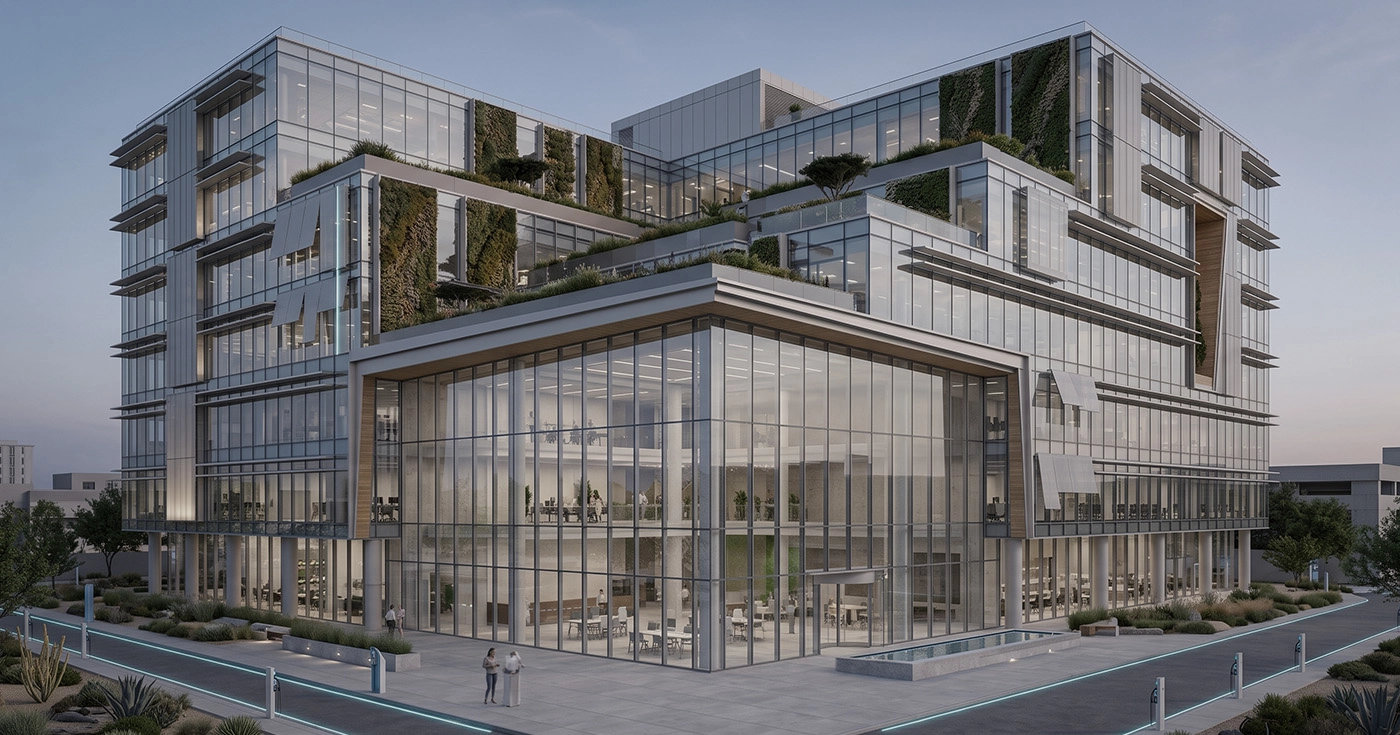

Technology is gaining importance in the management and repositioning of real estate assets, but its value should not be measured by the number of sensors, applications or systems installed. For an investor, the relevant question is different: does that technology really improve income, reduce costs or prevent the property from becoming obsolete?
The effect is especially visible in offices. JLL estimates that Madrid and Barcelona need around 5.8 billion euros of investment to modernise their office stock in central and financial locations. 90% of Madrid’s stock and 82% of Barcelona’s stock are more than ten years old.
This ageing is widening the gap between buildings capable of adapting to the new demands of occupiers and regulation and those at greater risk of losing competitiveness. In that process, technology is not an end in itself, but another tool to improve the asset’s performance.
What really makes a property ‘smart’
A smart building uses sensors, automation and data to dynamically manage energy consumption, air conditioning, occupancy, maintenance, access or security.
The difference compared with a conventional building lies in its ability to adjust its operation to actual use. Lighting or temperature can adapt to occupancy, a fault can be detected earlier, and managers can better understand how spaces are being used.
In that sense, the building stops being a relatively passive space and becomes a data-managed asset.
That does not mean that smart, sustainable and efficient are synonymous. In practice, value usually comes from the combination of technical quality, energy efficiency, technology and proper management.
Income, costs and obsolescence risk
Technology can create value in different ways. One is operational savings: more precise energy management, efficient systems or predictive maintenance tools can reduce consumption and anticipate incidents.
Another has to do with income. In certain markets, especially high-quality offices, occupiers increasingly value factors such as comfort, energy efficiency, connectivity and building services.
The data reflects this polarisation. In Madrid and Barcelona, Grade A properties accounted for around 50% of take-up during 2025, while buildings with sustainability certifications represented approximately 37% of leases. CBRE also estimates that, in Europe, certified offices command an average rental premium of close to 5.5% compared with comparable non-certified properties.
These figures do not prove that installing technology alone causes rents to increase. Higher-quality buildings usually combine better locations, design, efficiency and services at the same time.
That is why the third way of creating value may perhaps be the most important: reducing the risk of obsolescence. A property that does not respond to new requirements in terms of efficiency, comfort or environmental performance may lose demand or require significant future investment.
Retrofit gains prominence
This dynamic explains the growing interest in retrofit, that is, the comprehensive modernisation of existing buildings.
The process may include improvements in air conditioning and energy efficiency, the updating of facilities, new certifications, the redistribution of spaces or intelligent management systems.
JLL estimates that, in certain European office submarkets, repositioning medium-quality assets towards higher standards can allow rental premiums of approximately between 9% and 31%, depending on the city and location.
This is not a guarantee applicable to any property, but rather an example of the value gap that can exist between an obsolete asset and one capable of competing for higher-quality demand.
This logic is closely linked to value add strategies: investing in improving an asset with the aim of increasing its occupancy, rents or exit value.
At Urbanitae, we have seen this logic in operations such as Mazarredo II, where the planned investment forms part of a broader strategy of upgrading and value creation.
From artificial intelligence to predictive maintenance
Digitalisation is expanding the tools available to owners and operators. Occupancy data can help manage air conditioning and spaces more effectively; predictive maintenance makes it possible to anticipate incidents; and in operating assets such as hotels or flex living, technology can play a role in price management, consumption, access or services.
Artificial intelligence can help process that information and detect patterns, although its usefulness depends much more on the problem it solves than on the technology itself.
The key is to improve a specific economic variable of the asset: reducing a cost, avoiding a fault, increasing occupancy or managing the property better.
Technology also has a cost
Every technological improvement requires investment. An intelligent system can reduce consumption for years, but it also requires installation, maintenance, licences, updates and, when the time comes, replacement.
That is why the decision depends on whether those costs are offset by the savings generated, the higher income or the improvement in the property’s value.
There is also the risk of overcapitalising an asset: making a sophisticated technological investment in a building or location where users are not willing to pay for it.
Added to this are risks such as technological obsolescence, dependence on the provider, compatibility between systems and cybersecurity. A smart building is not an asset in which technology is installed once and then forgotten: it requires maintenance and updating.
How investors can participate
Private investors do not need to buy a smart building directly to gain exposure to this type of strategy.
Funds, SOCIMIs or participatory financing platforms can provide access to operations in which modernisation, energy efficiency or technical repositioning form part of value creation.
What matters is not that an investment is presented under the smart label, but understanding what improvements are planned, how much they will cost and what effect they are expected to have on rents, occupancy or expenses.
Technology is, ultimately, one more piece of the real estate thesis.
Value is not about having more technology
Smart buildings are gaining prominence because they can help manage assets better, reduce certain costs and adapt them to growing efficiency and quality requirements. However, there is no automatic premium for being smart.
Technology creates value when it solves a specific problem in the property and improves its competitive position. If it does not generate enough savings, income or commercial advantages to offset the investment required, it can simply become an additional cost and source of complexity.
For investors, therefore, the question is not how much technology a building incorporates, but whether that technology enables the asset to operate better and remain competitive for longer.