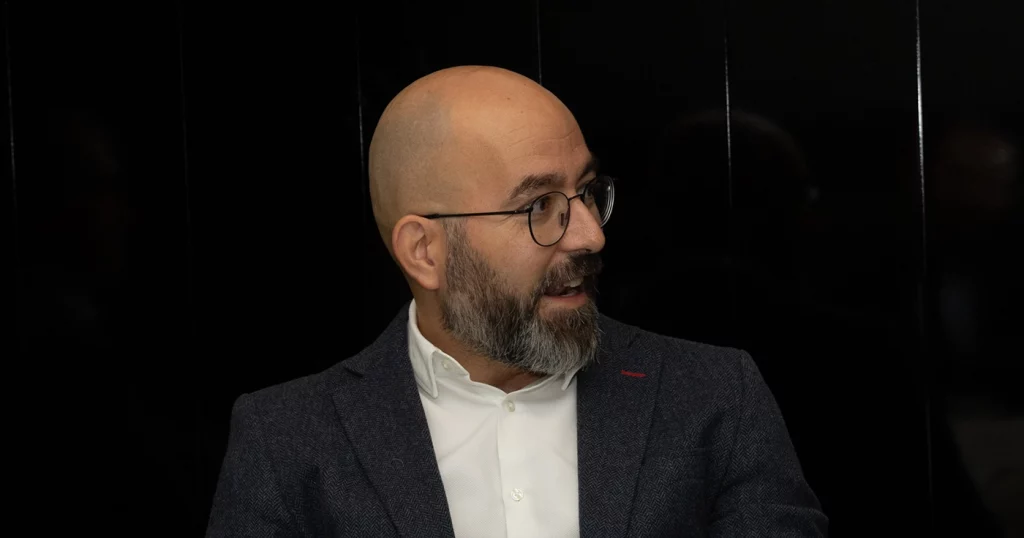
On October 16, Urbanitae participated alongside Confidencial Digital in a roundtable on financial education. We wanted to create a space to reflect on the state of financial education in Spain, its structural shortcomings, and its role as a tool for personal autonomy.
The debate, moderated by Fernando Alonso, partner at finReg360, brought together representatives from the financial and advisory sectors: Leonardo López (ODDO BHF), Jorge González-Iglesias (Gibobs Allbanks), Carlos García Ciriza (Aseafi), Sara Carbonell (Banco BIG), Victoria Torre (Self Bank), and Jaime Albella (CFA Society Spain). Urbanitae was represented by our CEO, Diego Bestard. Here are some of the topics discussed during the conversation.
The Culture of Money (and Silence)
During his speech, Diego Bestard emphasized that financial education in Spain is not only scarce but also remains a topic people tend to avoid. “In the United States, it is common to talk about money within families, at school, or with friends. Here it is still a taboo. Money is neither taught nor discussed, and this has consequences,” he stressed.
While in some neighboring countries students study business subjects as early as age 13, in Spain “home economics and basic personal finance management are still absent from the school curriculum,” he recalled.
In his view, financial education should be taught as a core subject, on par with English or mathematics. But it should also be seen as a cultural shift: “It’s not enough to learn about compound interest; we need to normalize conversations about money.”
Saving, Investing, and Planning
The lack of financial education directly affects people’s ability to save, invest, and plan for the future. Many Spaniards do not have a financial strategy or make full use of investment tools to grow their savings.
“You don’t need to be an economist, but everyone should have basic knowledge of personal finance. Managing income, expenses, and savings should be as fundamental as reading or writing,” said our CEO.
Several experts agreed on the tendency of Spaniards towards short-term thinking, which remains deeply rooted. For example, many consistently choose bank deposits when there are safe, profitable options that allow building long-term wealth.
Among the causes of this behavior, Diego pointed to lack of planning, excessive reliance on the public pension system, and limited tax education. “In Spain, there is a sense of social safety—State, family, friends—that, although positive, reduces the incentive to plan long-term,” he explained.
Digital Gap and New Generations
One of the most discussed topics was digital inclusion. While younger generations navigate the digital environment easily, a significant portion of the population still struggles to manage finances online.
Still, Bestard highlighted the positive role of technology: “Digitalization has democratized access to investing. Today, anyone can invest easily, safely, and transparently, without advanced knowledge.”
Not everything is positive. The younger generations show more curiosity and interest in investing and understanding money, but that curiosity must be paired with education and judgment. “Curiosity is good, but without knowledge it can lead to mistakes. Financial education must channel that energy into informed decisions.”
Spain and Europe: Two Speeds
Spain lags behind other European countries in financial education. The speakers agreed on the diagnosis: an educational system that does not prioritize practical training, a culture that avoids talking about money, and excessive reliance on the State to address future economic needs.
Despite this, there is room for optimism and a sense of opportunity. A shift in trends among younger generations is evident. “There is more interest, awareness, and willingness to learn. The key now is to provide the right tools,” said Bestard.
Our Commitment to Financial Education
At Urbanitae, we believe financial education is key to democratizing investment and fostering economic autonomy. That is why we launched Urbanitae Academy, a free platform that helps anyone—investors or not—acquire basic knowledge about saving, risk, and real estate investment.
We continue developing new content and courses to be released before the end of the year, with the goal of promoting a more open, conscious, and accessible financial culture for everyone.