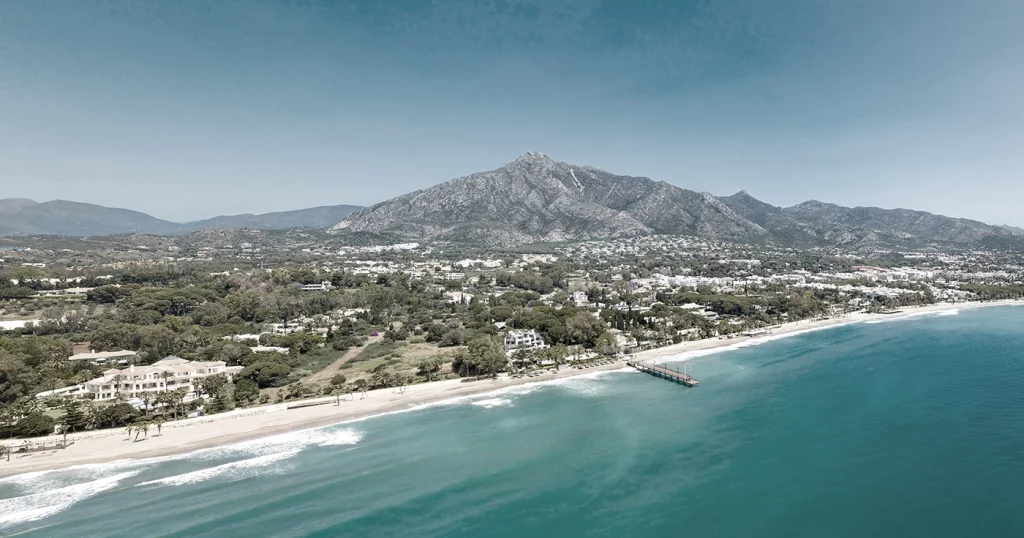
Buying a second home by the beach is a Spanish classic. Some do it for their own enjoyment, but others see it as an (almost) guaranteed investment. Buying, renting, or selling in these areas is good business, as demonstrated by the historical returns recorded since the boom in summer holidays back in the 1970s.
Despite fluctuations caused by the 2008 financial crisis or, more recently, the COVID-19 pandemic, the reality is that Spain’s coastlines remain the top choice for many investors, whether retail or institutional. This is due to improved infrastructure—like that seen on the Costa del Sol—the growth in vacation demand, and increasing tourism appeal. In fact, international tourist numbers could reach 100 million this year, according to the World Travel & Tourism Council (WTTC).
Best beach locations to invest in right now.
Real estate platform Fotocasa reveals in its latest report, ‘Profitability in Coastal Municipalities, Summer 2025’, that 22 coastal cities posted returns higher than the national average (6.5%) in June, demonstrating that these areas remain an excellent option for property investors.
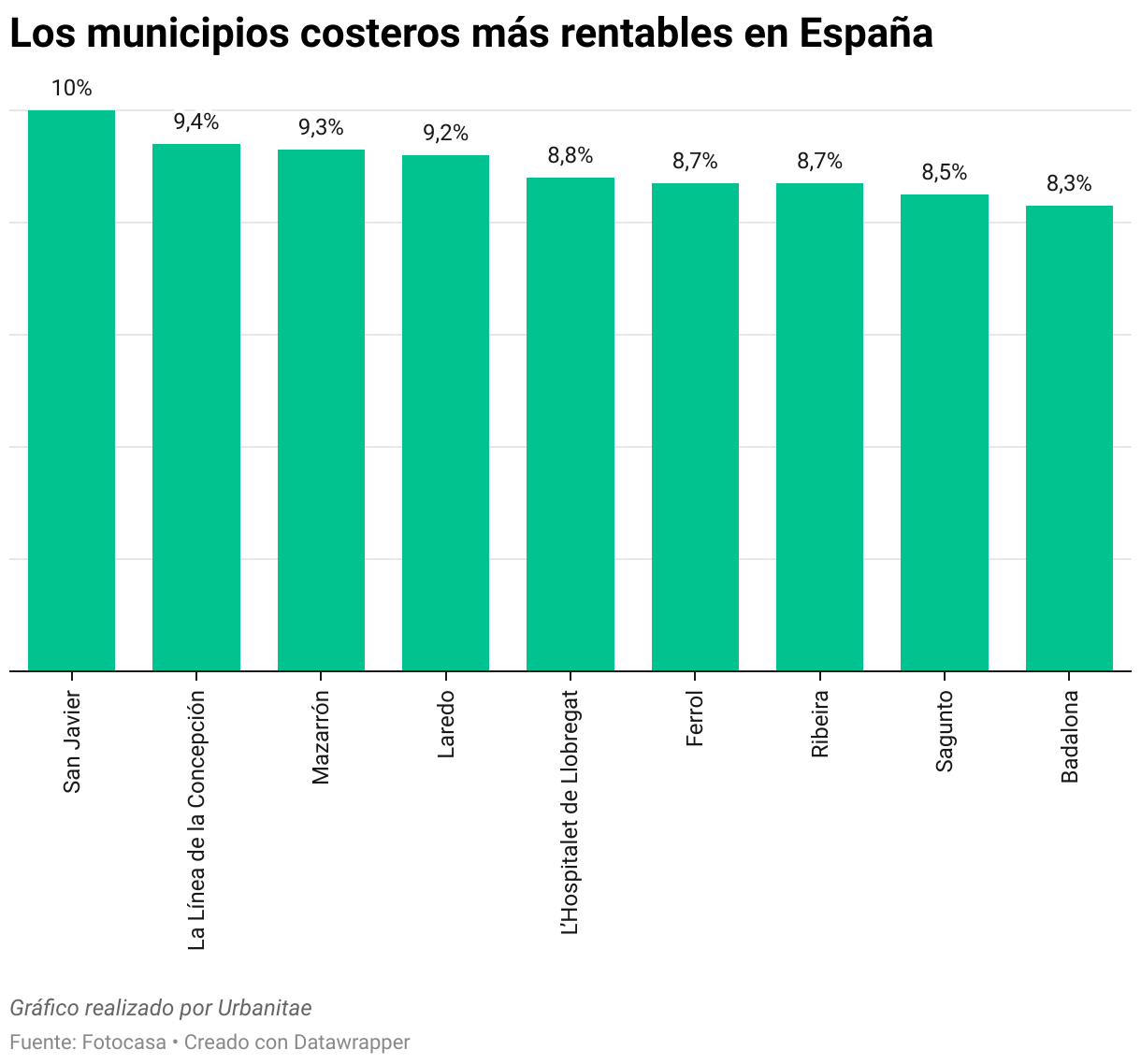
But which coastal cities are the most interesting for investment? Unsurprisingly, Andalusia tops the ranking with Adra (Almería), delivering a 13.7% return at mid-year, followed by San Javier (Murcia) with 10%—the only two municipalities in Spain reaching double-digit profitability.
They are followed by La Línea de la Concepción (9.4%), Mazarrón (9.3%), Laredo (9.2%), L’Hospitalet de Llobregat (8.8%), Ferrol (8.7%), Ribeira (8.7%), Sagunto (8.5%), Badalona (8.3%), and Foz (8.1%) as municipalities with returns above 8% in June. Similarly, the Catalan city of Mataró, as well as Cullera and Algeciras, all posted a return of 7.7%.
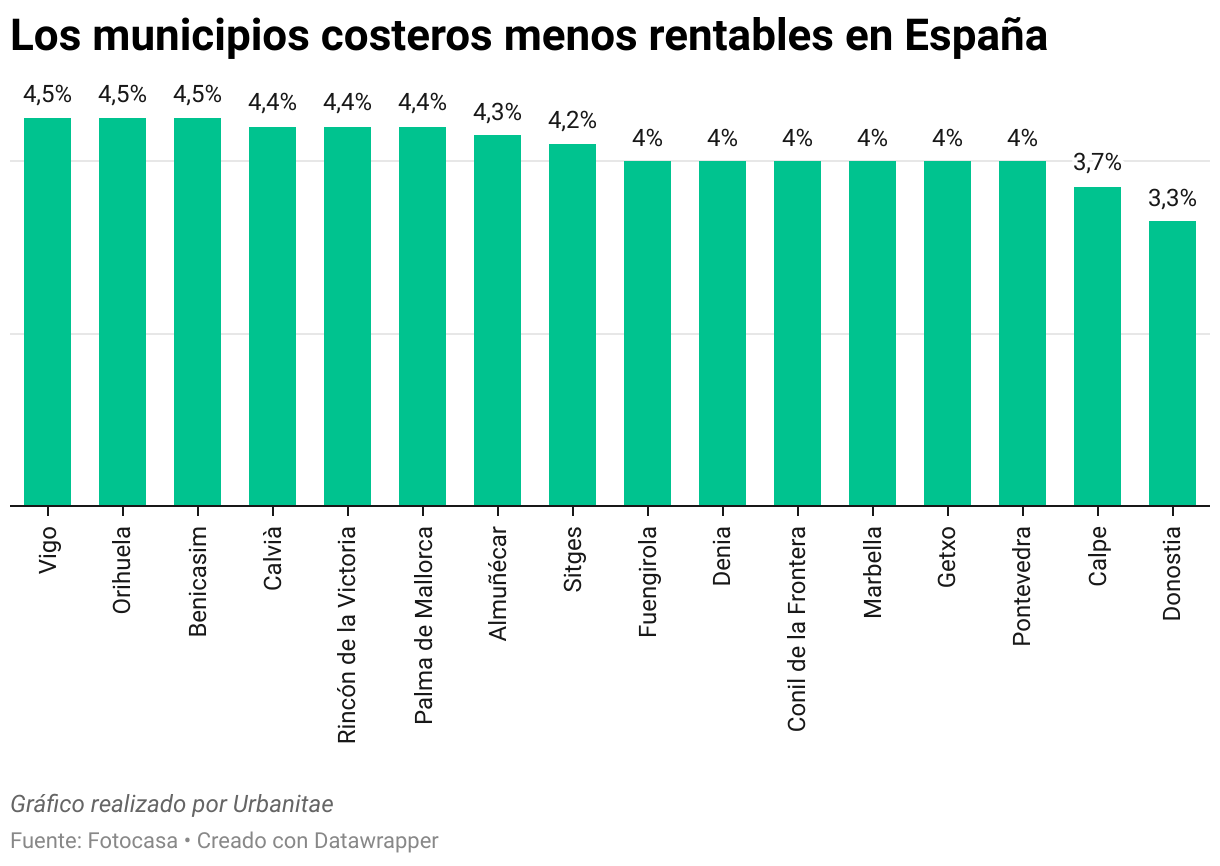
On the other end, the report also highlights coastal cities that have lost momentum, making them less profitable for investment in the current climate of rising prices. At the bottom of the list are Donostia – San Sebastián (3.3%), Calpe (3.7%), Fuengirola (4.0%), Dénia (4.0%), Conil de la Frontera (4.0%), Marbella (4.0%), Getxo (4.0%), Pontevedra (4.0%), Sitges (4.2%), and Almuñécar (4.3%).
Among these lower-yielding locations, one common factor explains the decline: they are highly sought-after areas, with a strong presence of both national and international buyers, a prime profile, and property prices ranging between €5,000 and €7,000 per square meter.En contraposición, el informe también destaca las ciudades costeras que han perdido más fuelle y que, por tanto, son menos rentables para invertir con el escenario actual de encarecimiento de precios. Así, en lo más bajo de la lista encontramos Donostia – San Sebastián (3,3%), Calpe (3,7%), Fuengirola (4,0%), Denia (4,0%), Conil de la Frontera (4,0%), Marbella (4,0%), Getxo (4,0%), Pontevedra (4,0%), Sitges (4,2%), Almuñécar (4,3%).
Cities vs. outskirts: where are returns higher today?
In recent years, we’ve seen exponential growth in property profitability in cities like Madrid, Barcelona, and Valencia, especially in their city centers. However, according to the Spanish Tax Agency’s latest report, a divergence is emerging between central and peripheral areas of large cities, with returns that often fall short of owner expectations and seem disconnected from property characteristics or location.
In 2023 (the latest available data), cities like Madrid saw the highest returns in modest neighborhoods such as Entrevías and Pavones, with 8% and 7%, respectively, while central areas like Centro Goya, Justicia, Recoletos, or Almagro—all within the M-30 ring road—did not even reach 4%.
The reason is clear: purchase prices are high relative to the rental income, leading to reduced, often unavoidable, profitability—even when tenants are paying high monthly rents.
Urbanitae’s coastal projects
Urbanitae has strengthened its presence in coastal areas with a solid portfolio of projects, positioning itself as one of the leading players in financing real estate developments in these regions. To date, the platform has financed over 100 projects along the Iberian Peninsula’s beaches, totaling more than €260 million in investment, resulting in the construction of over 3,500 homes.
These projects represent 54% of Urbanitae’s total financed volume since its inception, underscoring its strategic focus on coastal areas—a sector with strong revaluation potential and high demand, from residents, tourists, and investors alike.
Andalusia accounts for the largest share of investment in Urbanitae’s coastal projects, with a total of €130.6 million, followed by the Balearic Islands (€41.9 million) and the Valencian Community (€30.9 million). Among the top locations, Málaga province stands out, concentrating €114 million—representing 87% of investment in coastal residential projects in Andalusia.
At the international level, Urbanitae has also expanded into coastal markets outside Spain, particularly in Portugal, with €20.6 million invested in projects located in cities such as Cascais, Lisbon, and Oeiras.
In total, Urbanitae has successfully completed 20 projects in coastal areas, achieving an average IRR of 12.4% and an average duration of around 23 months. Altogether, more than €30 million has been returned to over 10,000 investors, solidifying Urbanitae’s position as a profitable and secure option for real estate investment on Spain’s beaches.
Frequently Asked Questions (FAQs)
What is a good return when investing in a beach property?
A reasonable benchmark is 6–9% gross in secondary locations with high occupancy. Net returns will be lower once you subtract homeowners’ association fees, property tax (IBI), insurance, maintenance, and management costs.
What are the risks of investing in a beach property?
Regulatory changes, seasonality and reliance on tourism, wear and tear due to the marine climate, and financing costs. Mitigate these by reviewing local regulations, getting adequate insurance, and diversifying.
Can I invest in coastal real estate without buying a property?
Yes. Through real estate crowdfunding and crowdlending in coastal development projects run by developers with a proven track record, with lower minimum tickets and diversification across locations and time horizons.