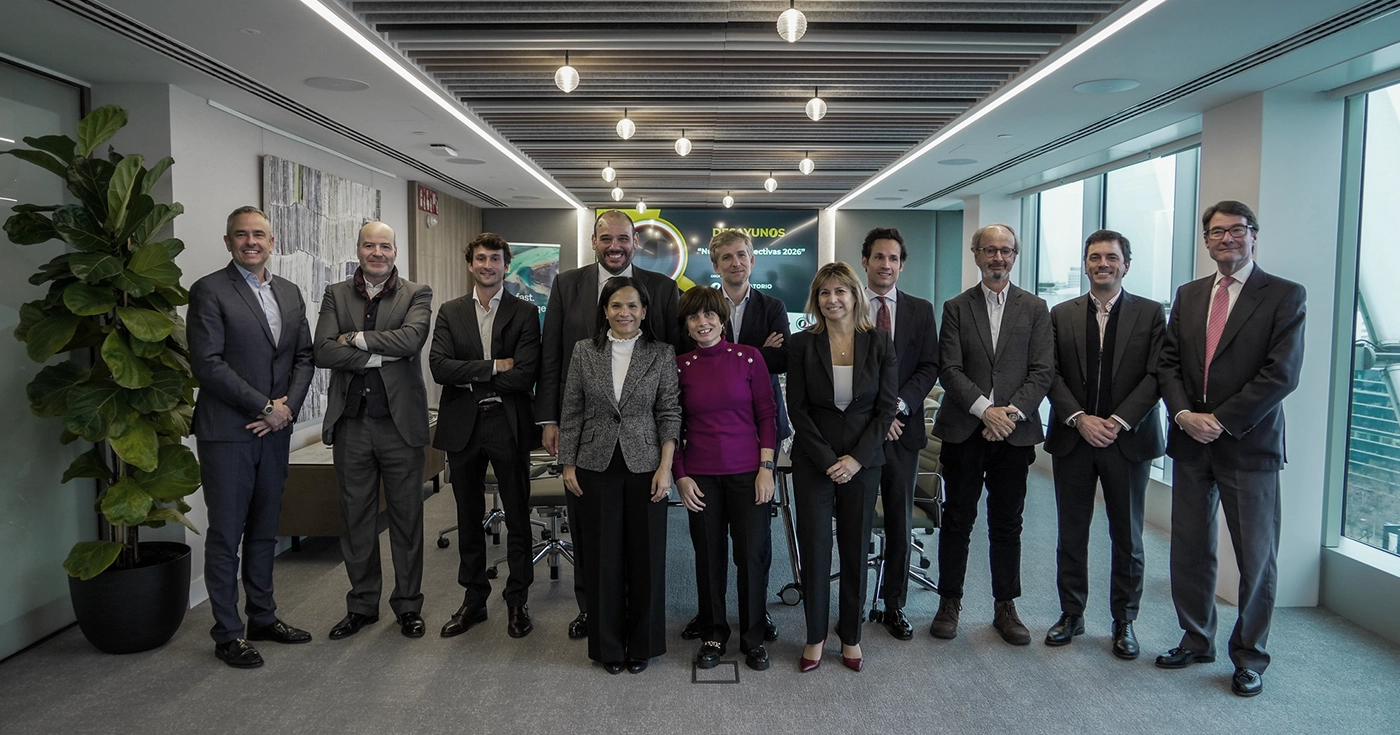

On 21 January, together with Observatorio Inmobiliario, we took part in an editorial breakfast hosted at Hogan Lovells. Representing Urbanitae, our Real Estate Director, Sergio Arana, joined a panel bringing together investors, lenders, developers, technicians, and advisors to focus on a very specific question: why does Spain attract so much real estate investment and yet we still can’t translate that capital into more housing?
Spain attracts investment (and living is still at the center)
The starting point was clear: Spain is an easy market to “sell” to investors. Víctor Iborra (Meridia Capital) summed it up with an idea repeated throughout the discussion: the equity story is solid, and “selling Spain is quite easy.”
From the banking side, Álvaro Morales (ING) described a “record” 2025, with strong activity and plenty of appetite to finance deals—with one condition: quality rules. “Not every kind of asset works,” he noted, emphasizing that liquidity concentrates when the asset truly fits.
And, as expected, living came up again and again as the star segment. But an important nuance surfaced too: it’s not enough for capital to look at living; the real question is what share of that capital actually helps increase supply.
The ROE problem
One of the day’s strongest messages landed here. Andrés Candela (Hogan Lovells) put it bluntly: we’re the investor’s “favorite,” but we don’t manage to get that money to fund housing development.
Carolina Roca (Asprima) explained why with figures, citing a BBVA Research analysis: the ROE of residential production/construction in Spain is roughly half that of other European countries. She brought it down to a definitive line: “I only convince an investor with profitability.”
As the debate unfolded, the factors weighing on that profitability kept repeating:
- overly rigid urban planning and lengthy processes,
- unpredictable timelines,
- taxation,
- and difficulty leveraging the raw material—land.
Uncertainty equals risk
If there was one cross-cutting consensus, it was this: the bottleneck isn’t lack of investor interest; it’s lack of certainty.
Orson Alcocer (Hogan Lovells) described the creation of buildable rights as “a kind of odyssey”, and was especially vivid about timelines and how hard they are to make “financeable”: between permitting and execution, ranges can be so wide that “they’re timelines that are very difficult to manage.”
From the bank’s perspective, ING translated that into committee logic: when planning moves on 20- to 40-year horizons, “taking it to committee is unthinkable.” That’s why it’s hard to step into pure land plays; appetite arrives when land is already fully entitled and the risk is more containable.
And from Urbanitae, Sergio Arana connected it to something we also see internally: our investment logic requires certainty, and the risk/timeline combination slows the entire sector—even with land that is already fully entitled, where delays can still appear.
From diagnosis to levers
Another part of the conversation turned toward the real capacity to produce more housing. Sandra Daza (Gesvalt) stressed there are no “magic recipes” and that the problem is structural: it can’t be solved “at the last minute like bad students.”
Along the same lines, Álvaro Diz (Avintia) defended industrialization as a lever to gain speed and efficiency, pointing to improvements in timelines and in end-product consumption, as well as a clearer value proposition for investors.
Diego Escario (Cano y Escario) widened the lens: rebuilding productive capacity requires industrialization, training, and rebuilding the ecosystem, in a country that has increasingly pivoted toward services.
Urbanitae’s role
At Urbanitae, this debate hits close to home for two reasons.
First, because—Sergio explained—we operate with ticket sizes and a level of granularity that doesn’t always fit purely institutional capital. We’re “a somewhat particular creature”: broader geographic focus, mostly residential, and a gradual widening into other segments, cautiously.
Second, because in an environment where the bank’s role is well defined, the biggest gap is often equity. At the breakfast, Sergio summed it up from our experience: we can help “by bringing more investment volume because equity is needed,” and shared a figure that shows the scale of what activating projects can do: “we will have brought 3,000 homes online” in 2025 alone.
Failure is not an option
As the conversation progressed, it became clear the goal isn’t for one niche of real estate to “do well,” but to regain the ability to produce housing at scale. Carolina Roca (Asprima) put it in direct social terms: “if we don’t succeed at this… the country’s social cohesion is at risk.”
Still, she ended on a note of hope: she argued we may be facing a potential urban planning paradigm shift, pointing to the draft LIDER Law in the Community of Madrid, opened to public consultation, as a route to greater agility and predictability.
In short: the investment is there. The 2026 challenge is turning it into delivered homes, with a framework that shortens timelines, reduces uncertainty, and improves the risk-return equation in development. And every lever matters: planning, permits, taxation, industrialization… and new capital pathways able to provide equity where the system needs it most.