The pandemic marked a turning point in the way we work, and although time has passed, the debate remains very much alive: office, remote work, or a hybrid model? Recent data shows that the hybrid model has become the norm. According to JLL’s Future of Work Survey, 56% of companies identify as “hybrid adopters,” implementing different levels of hybrid work: from nearly fully remote setups to arrangements combining several days in the office.
Persistence of the In-Person Component
The consolidation of the hybrid model does not prevent physical workspaces from maintaining an undisputed role. 85% of organizations require at least three days of in-office attendance per week, and 43% expect that number to increase by 2030. In other words, the office will continue to be a key meeting place, albeit under a more flexible framework than in previous decades.
This reality generates tensions between efficiency, cost, and investment. On one hand, companies project an increase in real estate budgets through 2030; on the other, they aim to maximize the utilization of their assets. Not surprisingly, more than 60% of organizations expect greater use of office spaces over the next five years.
Flexibility as a Strategic Pillar
Today, flexibility is not an add-on but has become an essential condition for competitiveness. This need also extends to real estate: companies decide where to locate and how to design their offices based on the spaces’ ability to adapt to new work standards.
In this context, the office segment is experiencing renewed dynamism in the investment market. Although still below pre-pandemic levels, according to CBRE, investment in this type of asset reached €1.5 billion in 2024, a 25% increase from the previous year.
Evolution in Prime Districts
The transformation is also reflected in major financial centers. Between 2020 and 2024, office leasing in CBDs (Central Business Districts) grew from 20% to 28%, while prime CBD rents in Europe recorded an average increase of 6.1%. In Q2 2025, office absorption on the continent advanced 10% year-on-year, reinforcing investor optimism, according to JLL.
The Rise of Flexible Spaces
A striking phenomenon is the growth of flexible office stock. In Madrid, it already reaches 358,000 m² (2.2% of the total), while in Barcelona it reaches 253,000 m² (3.1%). Overall, both cities have seen this segment grow by around 12% over the past five years.
Projections are clear: by 2030, flexible spaces could represent 8% of the total office stock in both cities. This leap is explained both by the opening of new centers and by the incorporation of flexible areas in existing buildings.
Operators at the Forefront
The market is led by a group of players that concentrate a large part of the supply. Over the past two years, IWG has accounted for 24% of openings, followed by Monday (10%), Loom House (9%), and Cloudworks (8%).
Looking at the operational stock, IWG still leads (25%), followed by WeWork (8%), Loom House (7%), First Workplace and Utopicus (5% each), and Áttico and Monday, with around 5% each.
However, the expansion of the model is not limited to specialized operators. According to JLL, 70% of office owners have already incorporated flexible solutions in at least one of their assets, thus expanding the offering and diversifying competition.
What the Offices of the Future Will Look Like
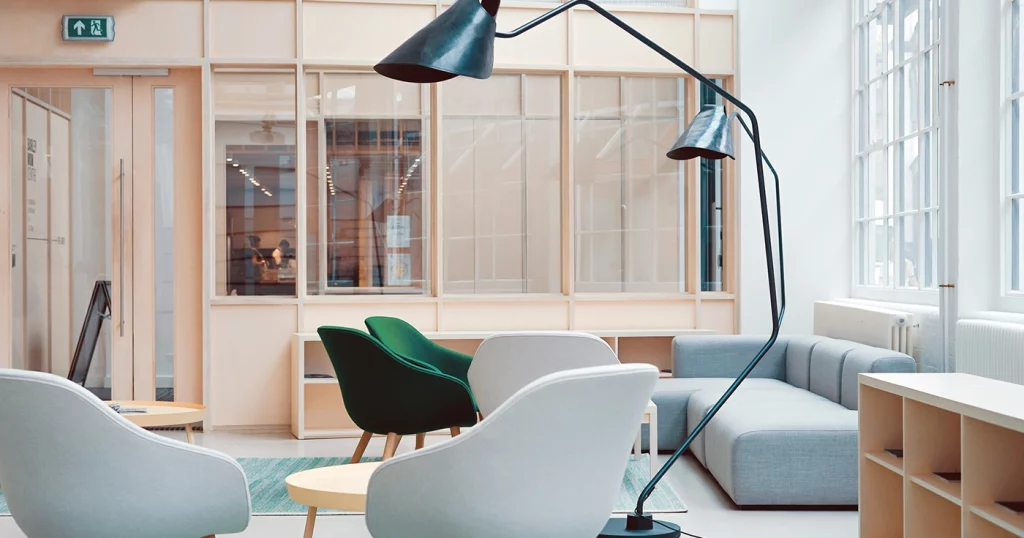
A CBRE report on the transformation of office spaces points to work environments that prioritize collaboration, sustainability, and user experience. These are more dynamic settings, with open areas that encourage interaction, technological solutions that support hybrid work, and ESG criteria integrated into design and management (CBRE). In this scenario, the office is redefined as a talent attraction hub rather than just a physical place.
In short, the convergence of hybrid work, flexible spaces, and real estate investment reflects a market in full transformation. Spain, with sustained investment growth and an increasing weight of flexible spaces in Madrid and Barcelona, positions itself as an interesting laboratory for these trends.